

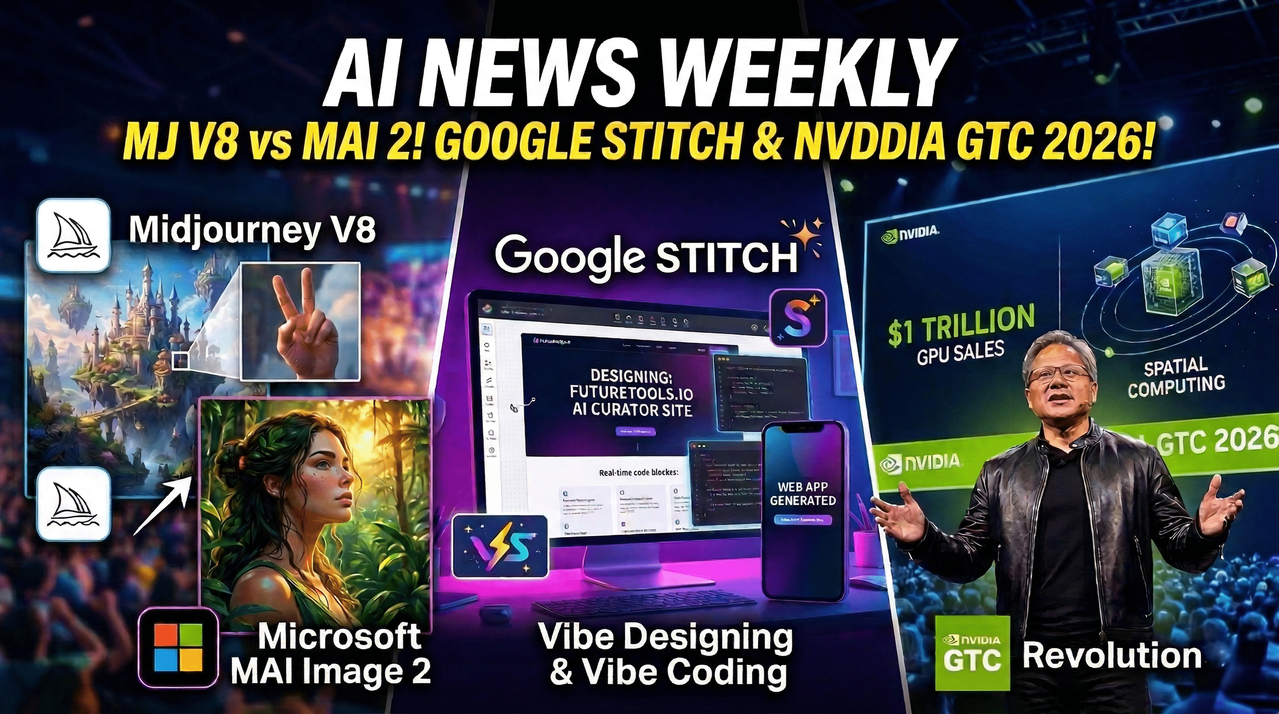
AI News Weekly:The Good, The Bad, and The "Vibe" Coding Revolution
There is a lot happening in the world of AI—so much so that it’s easy to get lost in the noise. I’ve spent the week filtering through the announcements to bring you what actually matters. From Midjourney’s latest (and slightly controversial) update to Google’s new design tools, let's jump right into the signal.
Midjourney V8: Better, Faster, Still Bad at Fingers?
Midjourney just dropped V8, and it’s a bit of a mixed bag. On paper, it’s a massive upgrade: better direction following, improved aesthetics through personalization, and—finally—better text rendering. They’ve also added an HD mode (2K resolution) and a faster web interface.
However, the "AI finger problem" has made a surprise comeback. While the model excels at surreal, fictional worlds, zoom-in tests show some mangled anatomy that we thought was a solved problem in 2024.
- The Verdict: It’s lightning fast and great for creative "vibe" shots, but if you need surgical precision or realistic human hands, you might still find yourself reaching for other tools.
🌧️ Microsoft MAI Image 2: The New Realism King?
While Midjourney was struggling with anatomy, Microsoft quietly released MAI Image 2. Currently ranked third on the Text-to-Image Arena (just behind Nano Banana and OpenAI), this model is all about photorealism.
- Accuracy: It handles physics—like water refraction and lighting—beautifully.
- Text: It nailed a complex coffee shop menu prompt with zero spelling errors.
- The Vibe: It feels like Apple-style product photography. If you want images that look like they exist in the real world, this is the one to watch.
🛠️ The Rise of the AI Agents: OpenClaw & Nemo Claw
The conversation has shifted from "chatbots" to "agents." These are systems that don't just talk; they do things.
Running Agents Securely
A big trend right now is running agents like OpenClaw on a VPS (Virtual Private Server) rather than your personal laptop. This keeps your sensitive files safe and allows the agent to run 24/7. Nvidia also jumped in with Nemo Claw, a version of OpenClaw with added security layers and one-click installation for their RTX hardware.
✨ Google’s "Vibe" Design & Coding Loop
Google had a massive week with two tools designed to work together: Stitch and AI Studio.
- Stitch: An AI-native design canvas (think "Figma, but with a brain"). You can speak to it, tell it to change color palettes, or generate three different website layouts in seconds.
- AI Studio (Full-Stack Vibe Coding): Once you have a design in Stitch, you can drop the assets into AI Studio. It will literally code the functional version of the site, complete with animations and hover effects, from a single prompt.
Pro-Tip: The "vibe design" to "vibe coding" loop is the future. Design the look in Stitch, then let Gemini build the logic in AI Studio.
🏎️ Nvidia GTC: The Trillion Dollar Forecast
Jensen Huang’s keynote at GTC was, as expected, massive. The headline? Nvidia expects $1 trillion in GPU sales through 2027.
- Space Computing: They are building GPUs (Vera Rubin modules) meant for space, though they're still figuring out how to cool them in a vacuum.
- DLSS5: A new upscaling tech for gamers that uses AI to "reskin" or improve graphics. It’s facing some backlash from purists, but it's optional.
- Nemo Claw: Bringing secure, always-on AI assistants to the enterprise.
📉 The Job Market: Is AI Taking Your Seat?
A new visualizer by Andrej Karpathy shows a stark reality. Jobs like bookkeeping, customer service, and clerical work are seeing a decline. However, trade jobs—electricians, plumbers, and carpenters—remain incredibly safe.
Interestingly, DoorDash is piloting a program where humans get paid to record everyday tasks and speak different languages to help train AI robotic systems. We’re seeing a shift where "entry-level" work might soon involve being a data provider for the models that will eventually do the work.
🚀 Rapid Fire LLM Updates
- OpenAI: Released GPT 5.4 Mini and Nano. They are cheaper and faster—perfect for agents that need to process thousands of tokens in the background.
- Claude: Now offers a 1-million-token context window for Opus 4.6 and Sonnet. You can basically feed it a library of books and it won't break a sweat.
- Mistral: Released Mistral Small 4, an open-weight model that punches way above its weight class in math and reasoning.
- Cursor: Introduced Composer 2, a coding model optimized for cost and performance. If you use Cursor to build apps, this is your new best friend.
Final Thoughts
The theme of the week is integration. We are moving past standalone chat boxes and toward a world where your design tool talks to your coding tool, and your AI agent lives on a secure server, working while you sleep.

Comments
No comments yet. Be the first to share your thoughts!
Leave a Comment