

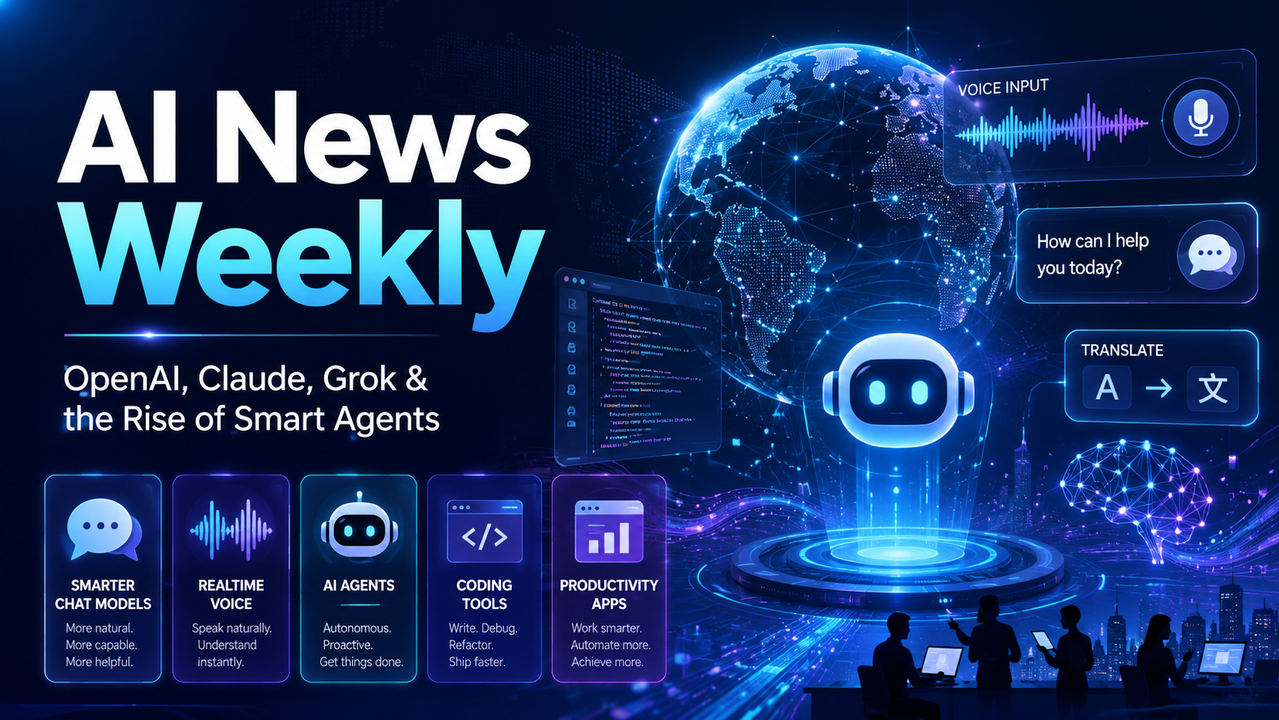
AI News Weekly Report: OpenAI, Claude, Grok, Codex, Adobe, Spotify, and the Future of Proactive AI
The artificial intelligence industry moved through another intense week of product launches, platform updates, strategic partnerships, and legal drama. From OpenAI’s new default ChatGPT model and advanced real-time voice systems to Anthropic’s expanded Claude limits, SpaceX compute partnership, and new agent memory features, the week showed one clear trend: AI is rapidly shifting from simple chatbots into more capable, proactive, multimodal assistants.
This report summarizes the major AI developments of the week and explains why they matter for developers, creators, businesses, marketers, and everyday technology users. The original source text highlights several major announcements across OpenAI, Anthropic, xAI, Adobe, Spotify, Apple, Nvidia, and other AI ecosystem players.
OpenAI Introduces GPT-5.5 Instant as the New ChatGPT Default
One of the biggest updates this week came from OpenAI with the release of GPT-5.5 Instant, now positioned as the new default model inside ChatGPT. This model is not being presented as a completely new frontier-level system, but rather as a refined and improved version of the previous default instant model.
For most users, the difference may not feel dramatic at first. However, GPT-5.5 Instant is designed to be smarter, more accurate, more concise, and more personalized. The model appears to produce clearer answers with less unnecessary explanation, while still improving reasoning quality in common use cases such as math, writing feedback, workplace communication, and personalized recommendations.
One of the main improvements is response efficiency. Earlier ChatGPT models sometimes gave long explanations even when the user needed a direct answer. GPT-5.5 Instant appears to reduce that friction by providing more focused responses. This matters because AI adoption depends not only on intelligence but also on usability. A model that answers clearly, quickly, and in a tone suited to the user can feel much more practical in daily workflows.
The update is available to ChatGPT users across free and paid plans, making it an important baseline improvement for millions of users. GPT-5.5 Instant is also available inside Microsoft 365 Copilot, extending its impact into productivity tools used by professionals, businesses, and enterprise teams.
OpenAI’s New Voice Intelligence Models Push AI Toward Natural Conversation
OpenAI also introduced new real-time voice models through its API. These include GPT Realtime 2, GPT Realtime Translate, and GPT Realtime Whisper. Together, these models represent a major step forward for voice-based AI applications.
GPT Realtime 2 is designed as a conversational voice model powered by GPT-5-class reasoning. This means it can handle more complex voice interactions, reason through user requests, and communicate naturally while using tools. The ability to keep users updated during reasoning or tool execution is especially important for voice agents, because delays in spoken interaction can feel awkward or confusing.
GPT Realtime Translate is another major development. It can translate speech from more than 70 input languages into 13 output languages while keeping pace with the speaker. This kind of live translation has strong potential for international meetings, customer support, education, travel, and accessibility. Instead of waiting for full sentences before translating, the system can follow the speaker in real time, making conversations feel more fluid.
GPT Realtime Whisper focuses on live speech-to-text transcription. It transcribes speech while the speaker is still talking, which could improve meeting notes, live captions, voice commands, and AI-powered documentation workflows.
These models are currently available through the API rather than directly inside ChatGPT for general users. However, the direction is clear: OpenAI is building toward AI assistants that can listen, speak, translate, pause, resume, use tools, and remain context-aware throughout a conversation.
Trusted Contacts Add a New Safety Layer to ChatGPT
Another important ChatGPT feature mentioned this week is trusted contacts. This optional safety feature allows adult users to nominate someone they trust, such as a family member, friend, or caregiver. If automated systems and trained reviewers detect a serious concern involving self-harm discussions, the trusted contact may be notified.
This feature reflects a growing focus on AI safety in consumer products. As people increasingly use AI tools for emotional support, personal questions, and private conversations, platforms are under pressure to build safeguards that balance user privacy with emergency support. Trusted contacts may become part of a broader trend in AI products where safety features are more personalized and user-controlled.
HubSpot Launches AEO for Answer Engine Optimization
The week also brought attention to HubSpot’s AEO tool, which stands for Answer Engine Optimization. Unlike traditional SEO, which focuses on ranking in search engines like Google, AEO focuses on how brands appear in AI-generated answers from tools such as ChatGPT, Gemini, and Perplexity.
This is a major shift for marketers. As more users ask AI assistants for product recommendations, brand comparisons, service providers, and buying advice, companies need to understand how they appear in AI responses. AEO tools can show which prompts trigger a brand mention, how the brand compares to competitors, and what actions might improve visibility.
For businesses, this is no longer a future concern. AI search is already influencing consumer decisions. Brands that ignore answer engines may lose visibility even if they perform well in traditional search results.
Codex Gains Chrome Integration and Playful Pets
OpenAI also updated Codex with new features, including a Chrome plugin for macOS and Windows. This integration allows Codex to interact with browser pages, analyze content, and assist with web-based workflows. While early testing suggests the feature may still be somewhat buggy, it points toward a future where coding agents can work directly across development environments, browsers, and external tools.
Codex also introduced “pets,” small customizable animated characters that live inside the Codex interface. While this feature is more playful than productivity-focused, it shows how AI platforms are experimenting with personality, customization, and user engagement. These small interface choices can make technical tools feel more approachable and personal.
Anthropic Expands Claude Limits and Partners with SpaceX
Anthropic made headlines with two major announcements. First, the company increased usage limits for Claude Code and the Claude API. This is significant because usage limits have been one of the biggest complaints among Claude users. Many developers and power users enjoy Claude’s performance but often hit limits during heavy workflows.
Second, Anthropic announced a compute partnership with SpaceX. The deal is expected to substantially increase Anthropic’s compute capacity. This is surprising because Elon Musk has publicly criticized Anthropic in the past. However, the partnership makes strategic sense in a market where compute is one of the most valuable resources in AI.
Anthropic has also committed heavily to cloud infrastructure through Google, showing that leading AI labs are racing not only on model quality but also on access to compute. In AI, infrastructure has become a competitive advantage. More compute means more capacity, better availability, larger workloads, and potentially faster model development.
Claude Managed Agents Introduce Dreaming and Better Memory
Anthropic also introduced new features for Claude managed agents, including dreaming, outcomes, multi-agent orchestration, and webhooks. The most interesting feature is dreaming.
Dreaming is described as a scheduled process that reviews past agent sessions and memory stores. It identifies patterns, recurring mistakes, shared preferences, and common workflows. Instead of simply storing memories, dreaming reorganizes and improves memory quality over time.
This could be a major step toward proactive AI. Traditional chatbots wait for users to ask questions. Proactive agents observe patterns and suggest improvements. For example, an AI system might notice that a user repeats the same workflow every Monday and then offer to automate it. It might detect recurring mistakes in a team’s process and suggest a fix.
This is where AI appears to be heading: from reactive assistants to systems that actively help users improve their workflows.
xAI Launches Grok 4.3 With Stronger Cost Efficiency
xAI also released Grok 4.3. The model reportedly improved significantly compared with earlier Grok versions, although it still may not be viewed as matching the very top models from OpenAI, Anthropic, or Google.
Its strongest advantage appears to be pricing. Grok 4.3 is positioned as a relatively capable model with lower usage costs. This matters because the AI market is not only about having the smartest model. Many businesses need models that are fast, affordable, and good enough for large-scale workloads. Cost efficiency could help Grok gain traction among developers and companies looking to reduce AI expenses.
OpenAI Trial Drama Reveals More About Leadership Tensions
The ongoing legal dispute involving Elon Musk and OpenAI also produced new revelations. Reports referenced in the source text mention claims about OpenAI co-founder Greg Brockman’s stake, past text exchanges, and testimony from former OpenAI CTO Mira Murati regarding safety review procedures.
The drama highlights a broader issue in the AI industry: governance. As AI companies become more powerful and valuable, questions about control, safety, nonprofit origins, commercial incentives, and leadership transparency are becoming more important. The OpenAI story is not just a company conflict. It reflects the wider tension between rapid AI commercialization and responsible deployment.
Adobe, Spotify, Apple, and Nvidia Push AI Into Everyday Life
Beyond the major AI labs, several other companies introduced AI-related developments.
Adobe Acrobat is adding AI features that let users summarize PDFs, chat with documents, generate presentations, create podcasts, translate files, and produce content from documents. This positions Acrobat closer to tools like NotebookLM, but inside a widely used document platform.
Spotify is enabling users to save personal AI-generated podcasts into their library. This could support daily briefings, custom learning content, business updates, or personalized news summaries created by AI agents.
Apple is reportedly developing AirPods with built-in cameras that could provide visual context to Siri and AI assistants. If this direction continues, wearables may become more context-aware, allowing AI to understand not only what users say but also what they see.
Nvidia and partners are exploring mini data centers for homes, using high-performance AI hardware installed in residential environments. This points to a possible future where personal or distributed compute becomes part of the AI infrastructure economy.
Final Analysis: AI Is Becoming More Personal, Proactive, and Embedded
The biggest theme from this week is not one single product launch. It is the direction of the entire AI industry. Models are becoming more concise and personalized. Voice systems are becoming more natural. Agents are becoming more proactive. AI tools are entering browsers, office apps, PDFs, podcasts, wearables, and even homes.
For businesses, this means AI visibility, automation, and workflow integration are becoming essential. For developers, it means voice APIs, browser agents, memory systems, and lower-cost models will create new product opportunities. For users, it means AI assistants will increasingly feel less like tools and more like active companions inside daily digital life.
The AI race is no longer only about who has the smartest chatbot. It is about who can build the most useful, trusted, connected, and proactive AI ecosystem. This week’s announcements show that the industry is moving quickly toward that future.

Comments
No comments yet. Be the first to share your thoughts!
Leave a Comment