

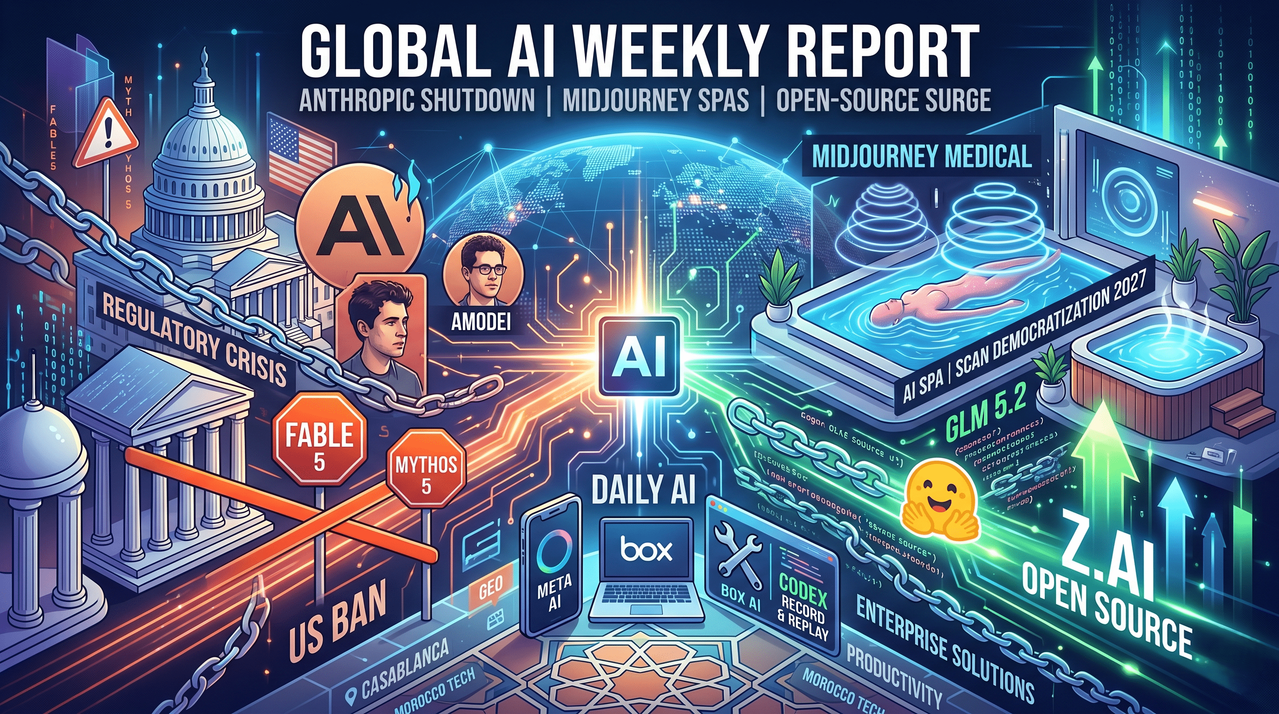
Global AI Weekly Report: Anthropic's Regulatory Crisis, Midjourney's Medical Leap, and the Open-Source Surge
The artificial intelligence landscape is evolving at a breakneck pace. Whether you are navigating the booming digital economy here in Casablanca, Morocco, or monitoring the foundation labs in Silicon Valley, keeping up with the daily influx of AI developments can be overwhelming. This week brought a seismic shift in AI regulation, unexpected hardware pivots from generative AI leaders, and a wave of new productivity tools.
Here is your comprehensive, hype-free report on the most critical AI news of the week, designed to cut through the noise and deliver clear, actionable insights.
The Unprecedented Government Takedown of Anthropic's Frontier Models
In a move that effectively rocked the global AI industry, the US government forced a publicly released commercial AI model off the market for the very first time. Anthropic was abruptly ordered to shut down its highly praised Fable 5 and Mythos 5 models for every user on Earth.
The mandate required Anthropic to suspend access to any foreign national, an impossible technical hurdle that left the company with no choice but to disable the models entirely to ensure compliance. Anthropic classified the underlying issue as a minor vulnerability, but the US government—reportedly viewing the company as a supply chain risk—disagreed.
What makes this situation particularly compelling is the underlying irony. For months, Anthropic’s leadership, including CEO Dario Amodei, championed strict AI regulation. Amodei recently published an essay arguing that frontier models should face rigorous, aviation-style auditing, and that the government should possess the authority to block or reverse releases that threaten public safety. The government has now exercised that exact authority.
Adding a layer of corporate intrigue, the whistleblower who flagged the security vulnerability to the Trump administration was reportedly Amazon CEO Andy Jassy. Given that Amazon is one of Anthropic’s largest investors and vendors, this dynamic has sparked intense speculation regarding the true motivations behind the shutdown.
The Investor Impact: This sets a terrifying precedent for the tech market. Anthropic’s last valuation sat at a staggering 965 billion dollars. For investors, the realization that the government can force an overnight shutdown of a flagship product fundamentally alters the risk profile of investing in foundation AI labs.
Enterprise Solutions and the Open-Source Catch-Up
While regulatory battles dominated the headlines, the open-source community and enterprise sectors continued their rapid advancement.
Solving the Enterprise Bottleneck with Box AI
The primary challenge for enterprise AI is no longer the models themselves, but supplying those models with accurate, company-specific context. According to recent reports, while 96% of organizations recognize that AI agents need access to internal data, only 36% have successfully connected them. Box AI is stepping in to solve this by transforming scattered content into structured, usable knowledge. Importantly, Box remains model-agnostic—supporting OpenAI, Anthropic, and Google—which alleviates widespread corporate fears of vendor lock-in.
Z.ai Disrupts with GLM 5.2
The open-source community scored a massive victory this week with Z.ai's release of GLM 5.2. Boasting 753 billion parameters and a 1 million token context window, this MIT-licensed model is designed specifically for long-horizon coding and agentic tasks. In blind taste tests and benchmark arenas, GLM 5.2 is performing at the level of frontier models, beating out GPT 5.5 in web development tasks and holding its own against Claude Opus 4.8.
The most disruptive aspect of GLM 5.2 is its cost efficiency:
| AI Model | Input Cost (per 1M tokens) | Output Cost (per 1M tokens) |
| Claude Fable 5 | $10.00 | $50.00 |
| Claude Opus 4.8 | $5.25 | $5.25 |
| GLM 5.2 | $1.40 | $4.40 |
Providing near state-of-the-art capabilities at a fraction of the cost, GLM 5.2 proves that open-weight models are closing the gap with proprietary giants faster than anticipated.
Social Media Integrations and Midjourney’s Bizarre Medical Pivot
Consumer-facing AI also saw peculiar and fascinating updates this week.
Meta AI on Facebook
Meta is rolling out new AI features across Facebook, heavily grounded in real-time public data from groups and reels. This approach mirrors the real-time sentiment analysis popularized by xAI's Grok. Alongside search capabilities, Meta introduced AI-driven photo editing features, allowing users to seamlessly swap clothing or manipulate transition effects in their uploads.
Midjourney Medical and the "AI Spa"
In perhaps the most unexpected news of the year, image generation giant Midjourney announced a new division: Midjourney Medical. Instead of software, they are developing a hardware replacement for MRI machines.
The device functions like a "dunk tank" that uses thousands of ultrasound transducers to bounce sound waves through water and into the body, creating highly detailed biological scans at a fraction of the cost and time of traditional MRIs. Midjourney’s ultimate goal is to democratize health screening by opening "Midjourney Spas" starting in San Francisco in 2027, where users can receive routine, preventative body scans in a cozy, relaxing environment.
While clinical experts like Hank Green have rightly pointed out that ultrasound cannot replace CT scans or MRIs for certain critical diagnostics (like looking through air-filled lungs), Midjourney's bootstrapped entry into health tech is a fascinating evolution of their CEO’s background in sensor technology.
Rapid-Fire Productivity Updates
The ecosystem of AI productivity tools expanded significantly this week with several quality-of-life updates aimed at professionals:
- OpenAI Codex "Record and Replay": This new feature allows users to record their screen while performing a repetitive digital task. The AI learns the workflow and creates a repeatable "skill" that can be executed via text prompt in the future.
- Claude Design Canvas: Users can now edit AI-generated code and designs directly within a unified workspace. It also supports bringing in existing repositories from GitHub and seamlessly integrates with platforms like Figma, Canva, and Vercel.
- Perplexity’s Self-Improving "Brain": Perplexity introduced a background memory system for its cloud agents. Over time, the AI reviews its own workflow history, learns from dead ends and user corrections, and optimizes its future model calls for greater efficiency.
- Adobe AI Assistant: Premiere, Illustrator, and InDesign are receiving deeper AI integrations, allowing editors to prompt the software to create sequences or generate assets without manually navigating complex timelines.
- Google Ask Ad Manager: Marketers running Google Ads now have access to a backend AI chatbot designed to analyze campaign metrics and suggest targeted optimizations.
Public Perception and Quirky Robotics
Finally, it is crucial to look at how these technologies are actually being received by the public.
A recent Pew Research survey revealed a complex duality in American public sentiment: while AI usage has surged (with 49% of adults reporting use of AI chatbots, up significantly from previous years), skepticism remains equally high. More adults believe AI will have a negative impact on society than a positive one.
This paradox highlights the nuanced reality of modern technology. The public appreciates the utility of tools like ChatGPT (which remains the dominant market leader, utilized by 44% of Americans) for daily productivity. However, there is growing exhaustion regarding the proliferation of "AI slop"—low-quality, AI-generated music and video content flooding social media algorithms, alongside the persistent threat of deepfakes. AI is not a monolith; users are learning to embrace its utilities while rejecting its digital pollution.
And on a lighter note regarding the future of automation: robotics company Shiaoban has unveiled a self-driving toilet. Designed primarily to assist individuals with severe mobility issues, the robotic unit can navigate a home, position itself bedside, clean itself, and autonomously empty its contents into standard plumbing before returning to a charging dock.
From massive regulatory battles to autonomous sanitation, the scope of artificial intelligence continues to expand into every facet of daily life.

Comments
No comments yet. Be the first to share your thoughts!
Leave a Comment