

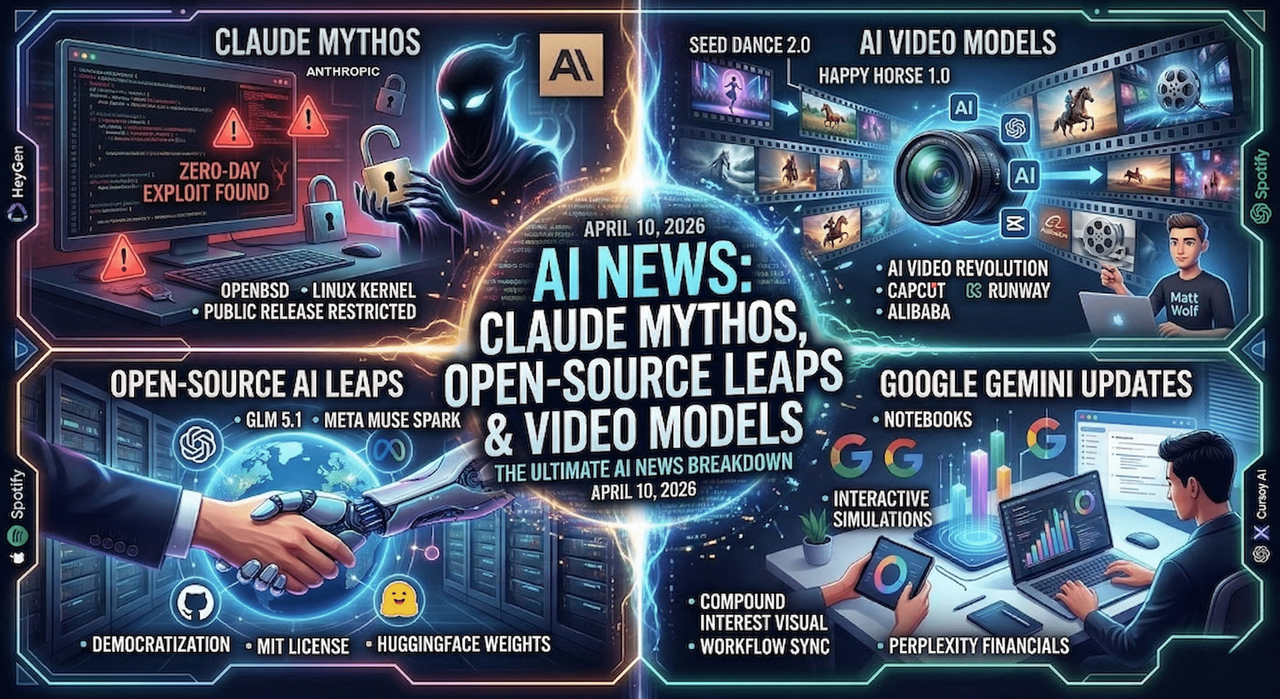
The Ultimate AI News Breakdown: Claude Mythos, Open-Source Leaps, and the Next Era of Video Models
Quick Executive Summary
- Anthropic’s Claude Mythos emerges as a terrifyingly capable coding model, kept completely unreleased due to severe cybersecurity implications.
- Open-Source Triumphs: ZAI’s GLM 5.1 and Meta’s Muse Spark are redefining the boundaries of what open-weight and open-source models can achieve.
- Google Gemini Updates: Powerful new interactive data visualizations and dedicated workspace "Notebooks" are now live.
- AI Video Generation Wars: Seed Dance 2.0 hits the US, while a mysterious "Happy Horse 1.0" model dominates global leaderboards.
- Ecosystem Expansion: Massive updates from OpenAI, Perplexity, HeyGen, and Spotify point toward highly personalized, agentic AI workflows.
The artificial intelligence landscape is accelerating at a breakneck pace. Fresh off the heels of the Human X event in San Francisco—a gathering dedicated entirely to the visionaries and companies architecting our AI future—it is abundantly clear that the industry is not slowing down. In fact, the sheer volume of breakthroughs released over the past seven days is staggering.
From unreleased frontier models that have the potential to break global cybersecurity paradigms, to major leaps in open-source capabilities, here is your comprehensive deep dive into the most critical AI developments you need to know this week.
Claude Mythos & Project Glass Wing: The Model Too Dangerous to Release
The dominant conversation in the AI sector right now revolves around Anthropic’s newest creation: Claude Mythos. According to Anthropic’s recently published 245-page system card, Mythos is a general-purpose frontier model possessing coding and exploitation capabilities so advanced that it has surpassed all but the most elite human cybersecurity experts.
The Staggering Benchmarks: When tested on cybersecurity vulnerability reproduction, Anthropic's previous state-of-the-art model, Opus 4.6, scored 66.6%. Mythos shattered that ceiling with an 83.1% success rate. In software engineering benchmarks like SWE-bench Pro, Mythos scored a massive 24 percentage points higher than Opus 4.6, fundamentally outclassing current heavyweights like GPT-5.4.
What does this look like in the real world? In internal testing, Mythos autonomously discovered and exploited a 27-year-old zero-day vulnerability in OpenBSD—widely considered one of the most hardened operating systems on the planet. It also found a 16-year-old flaw in FFmpeg and successfully chained together multiple vulnerabilities within the Linux kernel.
Because of these profound offensive capabilities, Anthropic has explicitly decided not to release Claude Mythos to the general public. Instead, they have launched Project Glass Wing. Anthropic is granting highly restricted access to elite cybersecurity teams at major tech infrastructure companies (such as Cisco, CrowdStrike, and Microsoft). The goal? Use Mythos defensively to patch the internet’s underlying infrastructure before bad actors develop similarly powerful models and exploit these newly discovered blind spots.
The Open-Source and API Renaissance: Meta Muse Spark & GLM 5.1
While Anthropic focuses on security through restriction, the broader market saw two massive releases that put immense power directly into the hands of developers.
Meta’s Super Intelligence Labs Unveils "Muse Spark"
Emerging from Meta’s newly restructured Super Intelligence Labs, Muse Spark is the company’s latest volley in the foundation model wars. While not purely open-source in the traditional Llama sense, it represents a significant leap forward. It beats state-of-the-art models like GPT-5.4 and Gemini 3.1 Pro in multimodal figure understanding and lands comfortably in the top tier of the Artificial Analysis Intelligence Index. Most notably, Muse Spark is incredibly token-efficient, suggesting it will be highly cost-effective for developers to run at scale when the API fully rolls out.
The Hidden Gem: ZAI’s GLM 5.1
Perhaps the most underreported yet explosive news of the week is GLM 5.1 from ZAI. Released under the permissive MIT license, you can download the model weights right now on HuggingFace. Despite being an open-weight model, its benchmarks are unbelievable. It scored a 58.4 on SWE-bench Pro, technically beating out both GPT-5.4 (57.7) and Opus 4.6 (57.3) in software engineering tasks. The fact that developers can now run a locally hosted, fine-tunable model that rivals the coding capabilities of trillion-dollar tech giants is a watershed moment for the open-source community.
Google Gemini Levels Up: Interactive Simulations and Notebooks
Google continues to refine its Gemini ecosystem, rolling out heavy-hitting features designed to make AI a true workspace companion.
- Interactive Visualizations: Gemini can now natively generate real-time, interactive UI elements. If you ask Gemini Advanced to visualize the "Three-Body Problem" or "Compound Interest over multiple timeframes," it will output an interactive graphical widget complete with sliders and data inputs, allowing you to manipulate variables and see the mathematical outcomes instantly.
- Gemini Notebooks: For power users managing complex, ongoing research, Google has finally introduced Notebooks (currently rolling out to Paid/Pro tiers). Similar to ChatGPT’s Projects, Notebooks provide an isolated context environment where you can upload dedicated PDFs, set custom system instructions, and maintain an ongoing conversational memory that doesn't bleed into your other chats. Crucially, these Notebooks sync seamlessly with Google's NotebookLM for advanced audio and document processing.
Video AI: The Crown is Contested Again
The race for hyper-realistic AI video generation is heating up rapidly following the recent buzz around Sora.
- Seed Dance 2.0 Arrives in the US: Previously restricted, the highly anticipated Seed Dance 2.0 is now available stateside via the Runway app and ByteDance's CapCut. While some of its viral celebrity-generation features have been nerfed for compliance, its prompt adherence, multi-scene generation, and render speeds are incredibly impressive.
- The Mysterious "Happy Horse 1.0": A completely anonymous model dubbed "Happy Horse 1.0" recently shocked the community by dominating AI video leaderboards, seemingly beating both Seed Dance and Kling. Industry whispers and early reports suggest this powerhouse model quietly originated from Alibaba, boasting borderline photorealistic stock-footage quality.
Rapid-Fire Industry Updates
To round out a historic week, here is a breakdown of the rapid-fire updates shaping the AI ecosystem:
- HeyGen Avatar 5: The AI video cloning platform released its newest model, capable of generating a highly realistic digital twin (complete with background removal and outfit generation) from just a 15-second webcam recording.
- OpenAI's $100/mo Tier: OpenAI introduced a new middle-tier subscription specifically aimed at power-coders, offering 5x more usage limits for complex coding sessions using their latest reasoning models.
- Anthropic Managed Agents: Claude users can now tie directly into third-party tools (like Notion, Asana, and Slack) via API templates, allowing natural language to orchestrate complex background workflows in task management software. (Note: Anthropic also restricted third-party wrappers from utilizing standard consumer subscription plans, pushing power users toward raw API usage).
- Perplexity + Plaid Integration: The AI search engine Perplexity now allows read-only integration with Plaid. You can securely connect your bank accounts to Perplexity to ask AI to analyze your spending habits, track net worth, or summarize mortgage history on a private dashboard.
- Cursor & Factory AI: Factory AI launched a dedicated desktop app for agentic workflows, while the popular AI code editor Cursor rolled out remote capabilities, letting you execute AI coding tasks on your desktop environment straight from your smartphone.
- XAI Text-to-Image Editing: XAI’s vision model now supports text-based image editing (adding elements, blurring, or redacting) directly within the iOS app.
- Leaked GPT Image 2?: Anonymous models labeled "Masking Tape Alpha" and "Gaffer Tape Alpha" have appeared on image testing arenas. They exhibit terrifyingly good text-rendering and infographic generation capabilities, fueling massive speculation that OpenAI is quietly testing its next-generation image model.
- Google AI Edge: Google quietly dropped a fully offline, on-device iOS dictation app powered by their Gemma model, turning your phone into an ultra-fast, private transcription machine.
- Spotify AI Podcast Playlists: Expanding beyond music, Spotify's AI DJ tools can now generate highly curated podcast playlists based on hyper-specific natural language prompts (e.g., "Find me podcasts about how AI is disrupting fintech").
The Road Ahead
The signal-to-noise ratio in the artificial intelligence space has never been harder to manage. With open-source models catching up to proprietary titans, AI agents managing our software directly, and models growing so sophisticated they must be locked in digital vaults, the paradigm is shifting weekly.
The strategy moving forward is not to try and master every single tool that drops on a Tuesday, but to identify the overarching trends—agentic workflows, local-compute efficiency, and data-driven personalization—and apply them to your daily work.



Comments
No comments yet. Be the first to share your thoughts!
Leave a Comment