
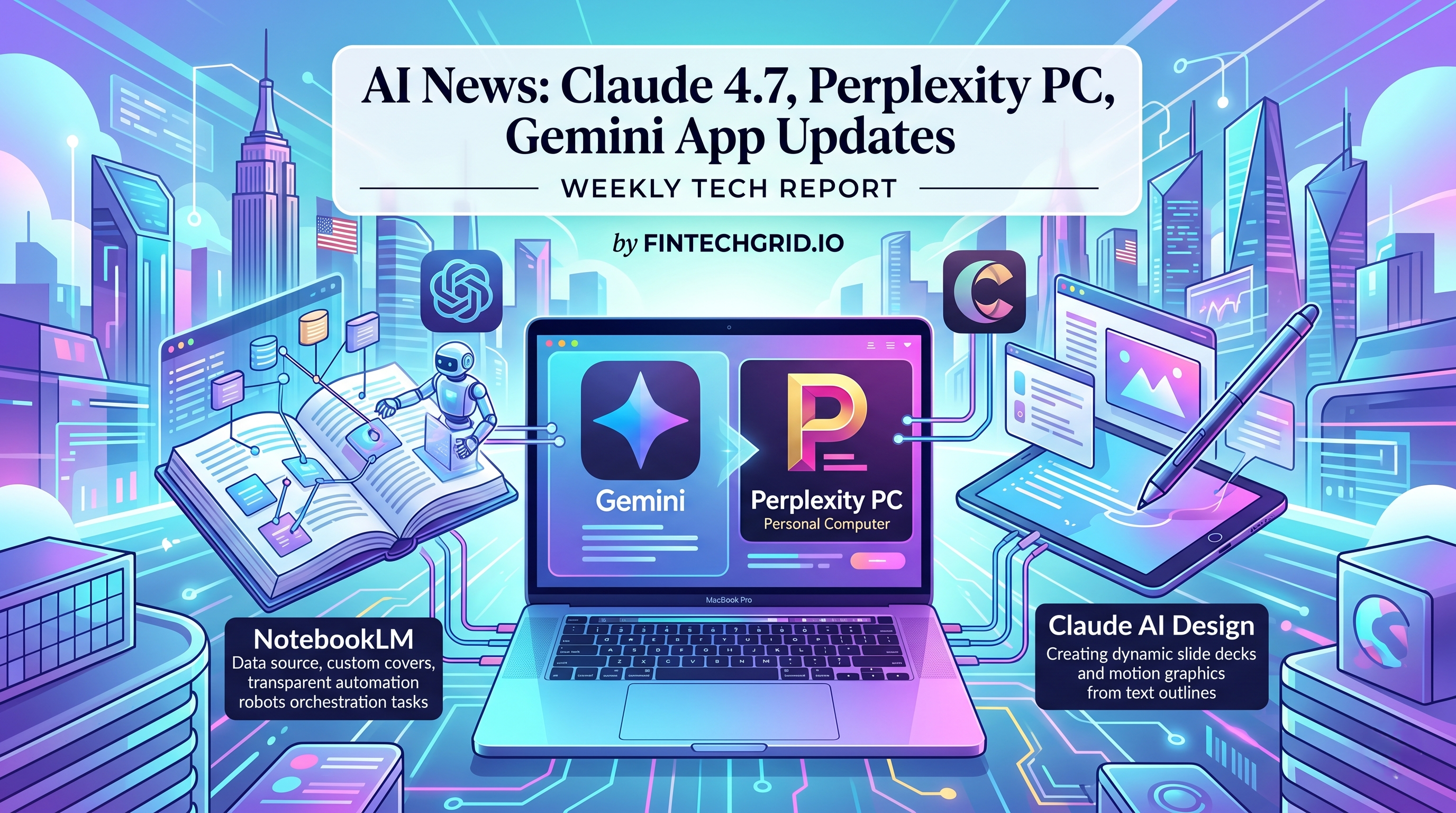
A Whirlwind Week in AI: Claude Opus 4.7, Perplexity’s Agentic PC, and Gemini’s Mac App
By mid-week, the tech world was anticipating a rare lull in artificial intelligence news. Instead, the industry delivered a massive wave of releases from nearly every major player in the generative AI space. From Anthropic’s quiet rollout of a highly capable new model to Google’s deepening ecosystem integration, and Perplexity’s ambitious leap into local computing, the landscape shifted dramatically in just a few days.
This report breaks down the week's most impactful updates, filtering out the heavy developer jargon to focus on how these AI tools are actively reshaping everyday workflows, digital design, and personal computing.
Key Takeaways
- Anthropic's Claude Opus 4.7 enters the market alongside a groundbreaking visual tool, Claude AI Design.
- Google Gemini launches a highly accessible native Mac application, while its Nano Banana 2 image model gains deep personal intelligence features.
- Perplexity Personal Computer signals a massive shift toward Agentic AI, automating tasks directly on local hardware.
- NotebookLM enhances user privacy and customization with deep, non-training Gemini integrations.
Anthropic’s Dual Strike: Opus 4.7 and Claude AI Design
The most viral update of the week stems from Anthropic, the team behind the Claude ecosystem. They have officially released Opus 4.7, an incremental but highly anticipated upgrade from their previous flagship, Opus 4.6. While Anthropic published a suite of impressive benchmark scores alongside the release, real-world utility often paints a different picture. Benchmarks can sometimes be optimized for specific testing environments, but everyday usability is where a model truly proves its worth.
Early adoption reveals a mixed but generally positive consensus. While some users notice minimal differences in basic conversational inquiries, those leveraging the model for complex logic, data structuring, and advanced writing find it noticeably sharper.
Alongside the model update, the standard Claude interface received a streamlined facelift. The "Co-work" feature has been relocated to a cleaner left-hand sidebar, and scheduled tasks are now neatly organized in a minimalist layout. However, the true showstopper is the unannounced launch of Claude AI Design.
Claude AI Design is a dedicated tool powered by Claude that specializes in generating high-quality prototypes, slide decks, and motion graphics. When tasked with transforming a standard text outline into a presentation, Claude AI Design vastly outperforms standard text-to-code interfaces. It actively engages the user, asking clarifying questions about design preferences, layout structures, and target audiences before generating the final product. Furthermore, its ability to generate seamless motion graphics from a single prompt and a reference screenshot is a major leap forward for digital content creators, eliminating the need for cumbersome traditional animation software.
The Gemini Ecosystem Expands its Footprint
Google has not remained idle, pushing significant updates across its Gemini product line. Most notably, Gemini finally has a dedicated, native application for Mac users. Designed with a sleek, minimalist aesthetic, the app's greatest strength is its global shortcut functionality (Option + Spacebar), allowing users to instantly summon the AI assistant from any screen or application without breaking their workflow.
Despite this convenience, the Mac app currently lacks full feature parity with the web version. Capabilities like custom "Gems" and "Notebooks" are conspicuously absent, and the rich text-editing options found in the web's canvas mode have not yet fully migrated to the desktop version. It serves as a solid foundational framework, but power users will likely find themselves returning to the web for deep editing tasks in the short term.
On the creative front, Gemini’s image generation tool, powered by the Nano Banana 2 model, has introduced a fascinating "Personal Intelligence" feature. By optionally linking with Google Photos and analyzing past chat histories, the AI now curates image outputs tailored to your specific interests and environment. For instance, if the AI recognizes a sustained interest in specific hobbies or digital tools based on your chat history, it will seamlessly weave those elements into generated avatars or conceptual art. While occasionally overzealous in its personalization, the technology represents a significant step toward hyper-tailored generative media.
Additionally, Google Chrome users will soon see the integration of "Skills" within the browser's Gemini prompt. This feature allows users to save repetitive prompts and workflows, triggering them instantly with a simple forward-slash command—a massive productivity boost for daily browser usage.
Perplexity Personal Computer: The Dawn of Agentic Workflows
Perhaps the most forward-looking announcement of the week is the Perplexity Personal Computer. Currently targeted at Mac Mini environments designed to run continuously, this tool represents a massive transition from traditional SaaS chatbots toward true Agentic AI.
Perplexity Personal Computer integrates directly with local file systems, native applications (like Mail, Notes, and Reminders), and core operating system functions. It essentially acts as an autonomous agent operating directly on your hardware. The standout feature is its "Watched Folders" capability. Users can designate specific directories on their hard drive for the AI to monitor in real time. When a new file is dropped into a watched folder—such as a raw document or a data spreadsheet—the AI automatically triggers a pre-defined workflow.
This means you could drop a text file into a designated folder, and the Perplexity agent would automatically read the document, execute a formatting task, and organize the output without any further human intervention. As the tech industry shifts heavily toward autonomous agents, Perplexity is positioning itself as a dominant force in local, automated productivity.
NotebookLM Enhances Privacy and Customization
Finally, Google’s popular NotebookLM received a suite of user-requested updates. Aesthetically, users can now customize their notebooks with custom 16:9 cover art and personalized summaries, making workspace organization far more intuitive and visually appealing.
More importantly, the integration between Gemini and NotebookLM has been deepened. Chats initiated within Gemini using NotebookLM sources are now saved bidirectionally. Crucially for privacy-conscious users and enterprise professionals, Google has explicitly confirmed that conversations referencing your personal NotebookLM sources inside the Gemini interface are not used to train their base models. Furthermore, querying these notebooks via Gemini does not consume your standard NotebookLM usage limits. This deep integration, previously locked behind the Google AI Pro tier, is now rolling out to free users across the United States and globally.
The Road Ahead
What began as a quiet week rapidly transformed into a showcase of the next generation of AI capabilities. From Anthropic’s design prowess to Google’s ecosystem expansion and Perplexity’s bold step into local agentic automation, the tools at our disposal are becoming more integrated, personalized, and autonomous. Staying ahead of these trends is no longer just an option; it is essential for anyone looking to optimize their daily digital workflows and maintain a competitive edge.

Comments
No comments yet. Be the first to share your thoughts!
Leave a Comment