AI-Native Development Platforms (2026): The Practical Report
Executive summary
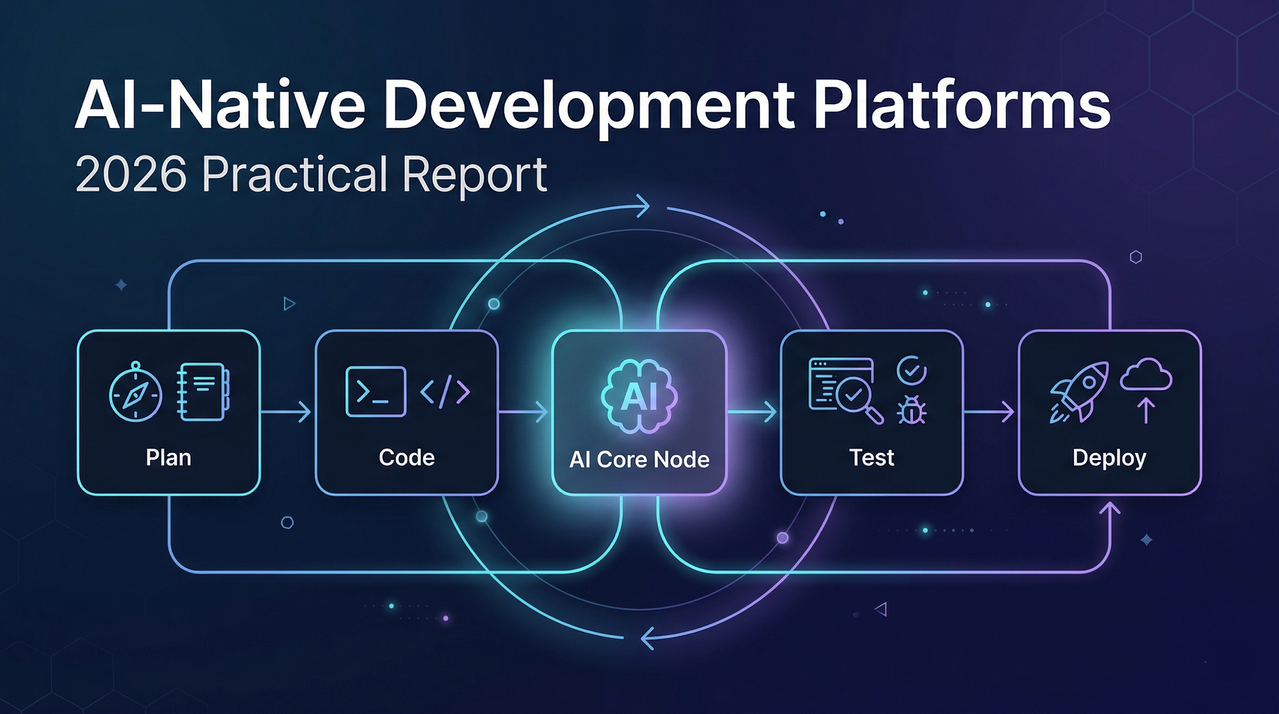
AI-native development platforms are not “another coding assistant.” They are a new software production layer where generative AI and agents are embedded across the software development lifecycle (SDLC)—from planning and coding to testing, security checks, and deployment. Gartner put AI-Native Development Platforms at the top of its strategic technology trends for 2026, framing them as a way for small, nimble teams to build software “fast, flexible, and increasingly enterprise-ready.” 1
The core idea is simple: move from AI that helps you type to AI that helps you ship—with guardrails strong enough for real organizations.
1) What is an AI-native development platform?
Gartner’s public 2026 trend briefing describes AI-native development platforms as platforms that use GenAI to create software “faster and easier than was previously possible,” enabling “tiny teams” paired with AI, and even allowing non-technical domain experts to produce software with governance guardrails in place. 2
Two details in that definition matter:
- AI is part of the platform, not a plugin. You don’t bolt a chatbot onto an old toolchain and call it “AI-native.”
- The target operating model is different. These platforms are meant to let “forward-deployed engineers” work directly with business teams, shrinking the distance between “what the business needs” and “what gets built.” 2
2) Why this is a top trend in 2026 (and what changes next)
Gartner’s 2026 materials place AI-native development platforms in the “Architect” theme—foundational capabilities that make the rest of an AI strategy easier to execute. 1
Gartner also ties the trend to a very specific workforce prediction: by 2030, AI-native development platforms will result in 80% of organizations evolving large software engineering teams into smaller, more nimble teams augmented by AI. 2
That doesn’t mean “engineers are obsolete.” It means the unit of delivery changes:
- From large teams coordinating via tickets, meetings, and handoffs
- To smaller teams coordinating via shared context + agents + automated guardrails
If you’ve lived through DevOps, then platform engineering, then internal developer portals… this is the next compression of complexity.
3) The capability stack: what “AI-native” actually includes
In practice, an AI-native development platform is a stack. Different vendors package it differently, but the capabilities tend to cluster like this:
A) AI inside the editor (baseline layer)
You still get the familiar features—inline completions, refactors, explanations, test generation—but “AI-native” platforms treat these as table stakes.
Example: Google’s Gemini Code Assist is positioned as SDLC-wide assistance (build, deploy, operate), with features like code completion, unit test generation, debugging help, and documentation support. 3
B) Agentic coding (the “step change” layer)
Agents execute multi-step tasks, often reading/writing files and running commands. This is where AI moves from “suggestions” to “actions.”
- Amazon describes an “agentic coding experience” for Amazon Q Developer that can read/write files, generate diffs, and run shell commands while incorporating developer feedback. 4
- Google documents Gemini Code Assist agent mode, including a caution that agent mode can affect resources and that there may be no “undo” for changes outside the IDE—an important clue that these tools are crossing the boundary into operational impact. 5
- GitHub announced Copilot agent mode, describing the ability to generate/refactor code across files from a single prompt and positioning it as a productivity boost across organizations. 6
C) Context and customization (the “enterprise reality” layer)
Enterprises don’t struggle because they can’t generate a sorting function. They struggle because:
- their repos are huge,
- their internal APIs are undocumented,
- and their “golden paths” are tribal knowledge.
So AI-native platforms invest heavily in context plumbing:
- indexing repositories,
- retrieving relevant internal docs,
- applying org-specific conventions,
- and logging what happened.
Gemini Code Assist Enterprise supports “code customization” by connecting to private repositories so suggestions can reflect internal libraries and styles. 7
D) Platform-level governance (the “don’t get fired” layer)
Once AI starts creating, transforming, and proposing production changes, you need controls:
- identity and access management,
- policy constraints,
- audit logs,
- secure defaults,
- and safe release gates.
Google provides configuration guidance for Gemini Code Assist logging, reflecting the need for operational visibility. 8
4) Where this intersects platform engineering (and why that matters)
If you already have a platform engineering team building an internal developer platform (IDP), you’re not starting from zero.
The CNCF describes platform engineering as building and maintaining development platforms that provide self-service for developer teams—often treating the platform “as a product.” 9
CNCF also summarizes a widely used definition of an internal developer platform: an IDP is “the sum of all the tech and tools” a platform team binds together to pave “golden paths” and reduce cognitive load. 10
The clean way to think about it
- IDP (Platform engineering) standardizes how software is built/deployed (golden paths).
- AI-native development platforms add a new production capability: natural language + agents as a first-class interface to those golden paths.
In other words, AI-native platforms don’t replace platform engineering. They supercharge it—if you wire the agents into your paved roads instead of letting them roam free.
5) Real-world examples (what this looks like in tooling)
To avoid vendor hype, here’s a grounded way to map today’s market: many “AI-native” stacks are built by combining (1) an AI coding layer, (2) a workflow/agent layer, and (3) governance/observability.
GitHub Copilot (coding + agent direction)
GitHub’s public announcement for Copilot agent mode signals the shift from chat/editing to agentic workflow across repositories. 6
Amazon Q Developer (agentic experience + enterprise controls)
AWS positions Amazon Q Developer as a generative AI assistant for software development, explicitly describing agentic behavior (files, diffs, shell commands) and also emphasizing privacy controls for Pro (for example, not using proprietary content for service improvement). 4
Gemini Code Assist (SDLC scope + customization + logging)
Gemini Code Assist is documented as supporting teams “throughout the software development lifecycle,” with contextual responses and citations, plus enterprise customization and configurable logging. 3
GitLab Duo Agent Platform (multi-agent workflow orchestration)
GitLab markets Duo Agent Platform around orchestrating multiple agents with project context inside GitLab, aligning closely with the “multiagent” direction in modern SDLCs. 11
The point isn’t that one product “wins.” The point is that the platform shape is converging: agentic workflows + repo context + governance.
6) The risk reality: speed is useless if it ships vulnerabilities
AI-native development platforms can accelerate output—but they can also accelerate mistakes.
Two large signals from the research ecosystem are hard to ignore:
- Veracode’s 2025 GenAI Code Security Report summary (released via Business Wire) reported that AI-generated code introduced security vulnerabilities in 45% of analyzed cases across curated tasks and many models. 12
- An arXiv large-scale GitHub study found thousands of CWE instances across AI-attributed code files (using static analysis), illustrating that security issues show up in real repositories—not just benchmarks. 13
What this means operationally
If you adopt AI-native development platforms, treat them like introducing a new, very fast junior engineer who:
- can produce a lot of code quickly,
- sometimes sounds confident when wrong,
- and needs consistent review, testing, and security gates.
This is exactly why Gartner’s framing includes guardrails and why platform teams become even more important in an AI-native org. 2
7) A practical adoption roadmap (what to do first)
Here’s a pragmatic approach I’ve seen work (and it aligns with the “platform team + guardrails” story Gartner highlights):
Phase 1 (Weeks 1–4): Establish safe defaults
- Standardize IDE extensions and access policies (who can use what, where code can be sent).
- Turn on logging/audit where available. 8
- Define “high-risk changes” that require human approval (auth, payments, infrastructure, secrets).
Phase 2 (Weeks 5–8): Wire agents into paved roads
- Connect AI workflows to templates: service scaffolds, CI pipelines, deployment manifests.
- Add “golden path” checks (lint, tests, SAST, dependency scanning) as non-negotiable gates.
Phase 3 (Weeks 9–12): Expand to domain experts—carefully
Gartner explicitly points to enabling non-technical domain experts with guardrails. 2
Do that, but start with:
- internal tools,
- reporting dashboards,
- workflow automations,
- and low-risk integrations.
Avoid starting with core transactional systems unless your controls are mature.
FAQ
Are AI-native development platforms the same as AI coding assistants?
Not really. Coding assistants live mostly in the editor. AI-native development platforms aim to embed GenAI and agents across the SDLC and support “tiny teams” shipping more software with governance. 2
Will AI-native development platforms reduce engineering headcount?
Gartner’s public prediction focuses on team shape: by 2030, many organizations evolve from large teams to smaller AI-augmented teams. That’s more about operating model transformation than a simple “cut staff” story. 2
What’s the biggest risk when adopting agentic coding?
Security and control. Research and industry reports show AI-generated code can include vulnerabilities at meaningful rates, so you need automated security gates and disciplined review. 12
Conclusion
In 2026, AI-native development platforms are becoming the new center of gravity for software delivery because they turn GenAI from a productivity feature into a production system: agents, context, platform workflows, and governance.
The winners won’t be the teams with the flashiest demos. They’ll be the teams that combine:
- platform engineering discipline (golden paths, self-service, “platform as product”), 9
- with
- agentic execution (real tasks completed end-to-end), 4
- and
- security gates that keep up with the new speed. 12
Comments
No comments yet. Be the first to share your thoughts!
Leave a Comment