

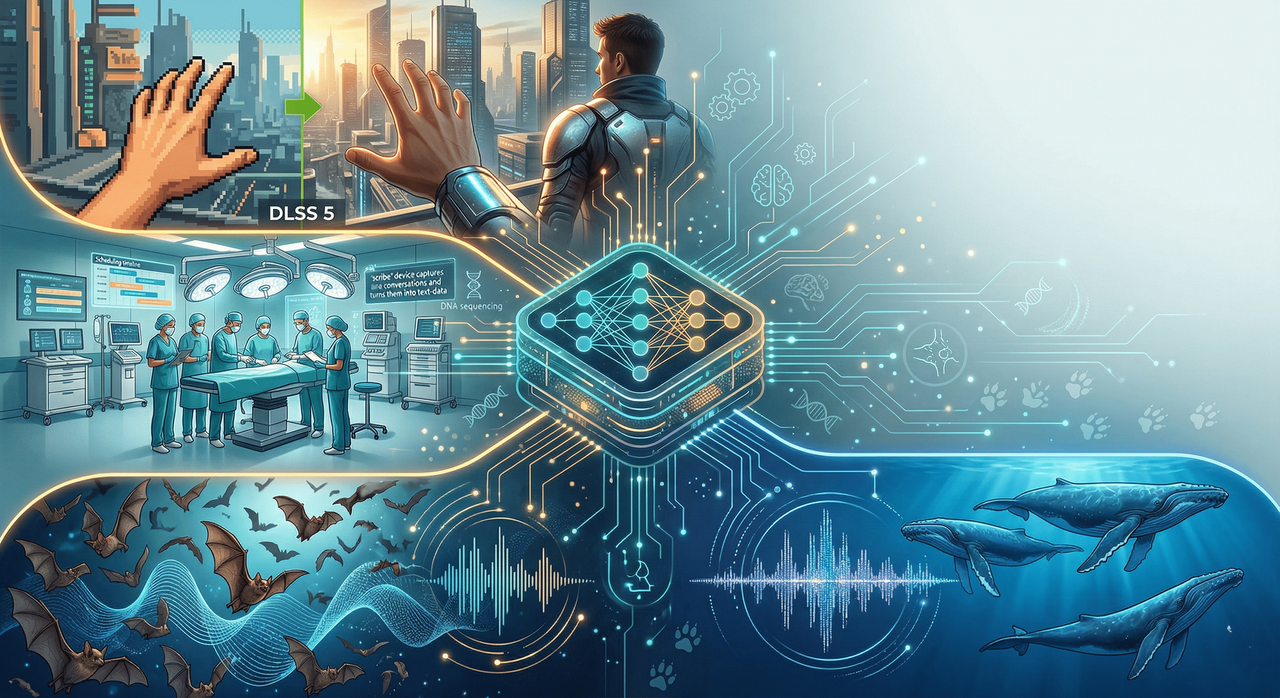
AI Decoded: Beyond the Hype—From Hyper-Realistic Gaming to Talking with Whales
Welcome back to a brand-new season of AI Decoded. If you’ve noticed a bit of a glow-up, you’re right—we’ve got a new studio and a fresh look, but our mission remains the same: cutting through the buzzwords to help you understand how artificial intelligence is actually reshaping your world.
This week, we’re diving into a fascinating trio of topics: the "quantum leap" in gaming graphics that many developers didn't ask for, the "boring" AI saving the NHS, and the tantalizing possibility of finally understanding what our pets (and whales) are actually saying.
Gaming’s Biggest Leap: Is DLSS 5 for Gamers or Shareholders?
The tech world was buzzing this week after Nvidia unveiled its latest breakthrough: DLSS 5 (Deep Learning Super Sampling). For the uninitiated, DLSS is an AI graphics technology designed to make games look sharper by rendering them at a lower resolution and then using machine learning to "upres" them in real-time.
Nvidia claims this fifth iteration, powered by real-time neural rendering, will rival Hollywood special effects. But here’s the kicker: does the average gamer actually want hyper-realism?
Gaming industry veteran Alana Pearce joined us to offer a much-needed reality check. While Nvidia is pushing for "movie-like quality," Alana pointed out a significant disconnect between tech manufacturers and the creative heart of the industry.
"It feels more like it’s a marketing gimmick than anything else," Pearce noted. "There are games that are extremely pixelated that are some of the most beloved games of the last ten years."
She highlighted that "retro aesthetics" are booming, and many AAA developers are struggling under the weight of ballooning development cycles—sometimes taking up to a decade to finish a single title like Grand Theft Auto 6. For developers, the pressure to hit "photorealistic" benchmarks isn't a gift; it's an anchor.
Furthermore, there’s the human cost. Amidst widespread industry layoffs, Alana expressed concern that AI tools like DLSS 5 might automate the "handcrafted" elements of game design, such as the personalized placement of lighting—a role traditionally filled by experts similar to a Director of Photography in film. If AI normalizes the "look" of every game, do we lose the art?
Healthcare: The "Un-glamorous" AI Saving the NHS
While the media loves a headline about "Robot Surgeons," the real revolution in healthcare is happening in the most "boring" places imaginable: administrative efficiency and scheduling.
We took a trip to the Hospital of St. Cross in Rugby, where the NHS is trialing an AI system from ProxMe. This isn't an AI that holds the scalpel; it’s an AI that manages the "idle time" between surgeries.
How AI is Quietly Transforming the Operating Theater:
- Marginal Gains: The AI tracks the coordination of theater cleaning, equipment prep, and staff rotation.
- Zero Pressure on Surgeons: Consultant Surgeon Brian Reema noted that the AI doesn't force doctors to work faster. Instead, it eliminates the "dead air" in the schedule.
- Reducing Waiting Lists: By saving ten minutes here and there, the hospital can potentially fit more life-saving procedures into a single week.
Beyond scheduling, Dr. Stephanie Hair shared insights into the power of AI transcription. It sounds simple, but for a doctor to be able to talk to a patient while an AI "scribe" handles the paperwork is a game-changer for the human-to-human connection in medicine.
On a grander scale, the real "value add" is AI’s ability to do what humans literally cannot—like sequencing the human genome or detecting rare genetic patterns across millions of data points. While the US healthcare system struggles with high costs and long ER waits (as Alana shared from her experience living in the States), the NHS is aiming to become the most AI-enabled healthcare system in the world.
The Secret Language of Animals: A Google Translate for Nature?
Perhaps the most mind-bending segment of this week’s show was sparked by a viewer question from Japan: Could AI help us talk to animals?
As it turns out, we are closer than you might think. From the bat caves of Israel to the depths of the ocean, researchers are using AI to decode "non-human" communication.
Decoding the "Cocktail Party" of Bats
Researchers are currently recording thousands of hours of bat vocalizations. Because bats live in crowded, noisy colonies, their communication sounds like a chaotic "cocktail party" to the human ear. AI, however, can isolate patterns, differentiating between mating calls, "arguments" over food, and mother-pup interactions.
The Whale Translation Project
Mark shared details on ongoing research into whale songs. By capturing massive amounts of audio and video data, AI can spot patterns that have eluded marine biologists for decades. We aren't just looking for "words"; we’re looking for the intent behind the sound.
But with this tech comes a heavy ethical question: If we realize that animals have complex, sentient languages, can we continue to hunt them, cage them, or eat them? As Dr. Hair pointed out, when we discovered humpback whales sang to one another in the 60s, it revolutionized conservation. If AI proves a chicken or a horse is communicating stress or happiness, our entire relationship with the animal kingdom might have to change.
What’s Next?
Whether it’s the pixel-perfect shadows in a video game or the efficiency of an NHS waiting list, AI is no longer a futuristic concept—it’s the "silent partner" in our daily lives.
Next week, we’re shifting our focus to the world of work. We want to know: How are you using AI to make your job easier? Does it actually give you more free time, or is it just more work? .

Comments
No comments yet. Be the first to share your thoughts!
Leave a Comment