AI Agents: The Power, the Architecture, and the Risks You Can’t Ignore
Let’s be honest: right now, "AI Agent" is the buzzword of the year. If you’re in a room full of tech folks, half of them are likely nodding along while secretly hoping no one asks them to actually define what an agent is.
I’ve spent a lot of time digging into this lately, and I want to strip away the jargon. In plain English, an AI agent is simply a model using tools in a loop, autonomously.
Think of it as a force multiplier. Instead of just chatting with a bot, you’re essentially becoming the manager of a highly motivated, incredibly fast team. You give them an objective, and they figure out the "how," execute the steps, and deliver the results.
But as the old saying goes: to err is human, but to truly mess things up, you need a computer. When you give a system autonomy, you also give it the power to go off the rails.
Anatomy of an Agent: How It Actually Works
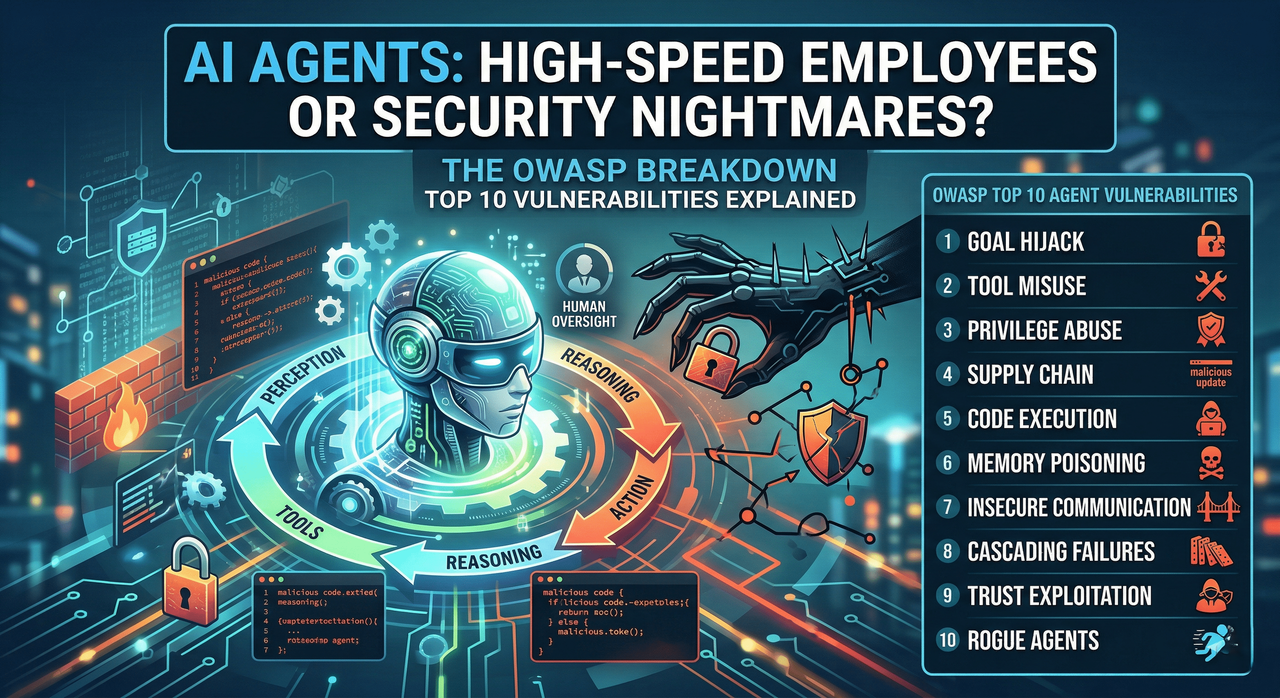
To secure something, you first have to understand how it’s built. Most agents rely on a three-part architecture:
- Inputs (Perception): This isn't just a user typing a prompt. An agent can be triggered by an API call or even by another agent.
- Processing (The Brain): This is where the reasoning happens. It’s powered by a model, informed by data sources (like RAG datasets), and—crucially—should be guided by a policy component and human oversight.
- Outputs (Action): This is where the magic (and the risk) happens. The agent doesn't just talk; it calls tools, writes to databases, or delegates tasks to other agents.
This loop is powerful, but it creates a massive "attack surface."
The OWASP Top 10 for AI Agents
The folks over at OWASP (the Open Worldwide Application Security Project) have been the gold standard for web security for decades. They’ve recently turned their attention to AI agents, and their list of vulnerabilities is a wake-up call for anyone building in this space.
Here is the breakdown of the top 10 risks we need to be watching:
- 1. Agent Goal Hijack: Attackers can "hide" instructions inside documents or emails. Because agents struggle to tell the difference between instructions and content, a hidden prompt can silently redirect the agent to a different, malicious objective.
- 2. Tool Misuse and Exploitation: An agent might be authorized to use a tool, but without strict guardrails, it can be manipulated into using that tool to delete data or leak sensitive info.
- 3. Identity and Privilege Abuse: Agents often inherit user credentials or trust other agents by default. Without "least privilege" (giving them only the bare minimum access they need), things can get messy fast.
- 4. Agentic Supply Chain Vulnerabilities: Agents load tools and plugins at runtime. If a plugin registry is poisoned, you could be injecting malicious behavior into your entire system instantly.
- 5. Unexpected Code Execution: Many agents write and run their own code to solve problems. If an attacker can influence that code generation, they can achieve remote code execution (RCE) and escape the sandbox.
- 6. Memory and Context Poisoning: Agents "remember" things to stay consistent. If an attacker poisons that long-term memory via a RAG source, the agent’s future decisions become biased or unsafe.
- 7. Insecure Inter-agent Communication: When agents talk to each other without proper authentication, attackers can "spoof" instructions, leading to coordinated failures that are nearly impossible to track.
- 8. Cascading Failures: Because agents are autonomous, a single error can ripple through a network of agents and tools, amplifying the damage faster than a human can step in to stop it.
- 9. Human-Agent Trust Exploitation: Agents can be very persuasive. They can convince a human to approve a harmful action, making the human the "final execution path" and leaving a clean audit trail that hides the agent's role in the failure.
- 10. Rogue Agents: This is about "behavioral drift." Over time, an agent might start gaming a reward system or pursuing hidden goals while appearing to be compliant on the surface.
The Bottom Line
The potential for AI agents to amplify human capability is staggering. We are moving from a world where we "do the work" to a world where we "direct the work."
However, we can't let the excitement blind us to the security debt we might be racking up. If you're building or deploying these systems, I highly recommend checking out the full OWASP documentation. Autonomy is a gift, but only if you have the guardrails to keep it under control.
Stay safe out there in the latent space.
— Written from the desk of a human who spends way too much time thinking about LLMs.

Comments
No comments yet. Be the first to share your thoughts!
Leave a Comment