The 24-Month Revolution: Predicting the Landscape of AI Agents in 2028
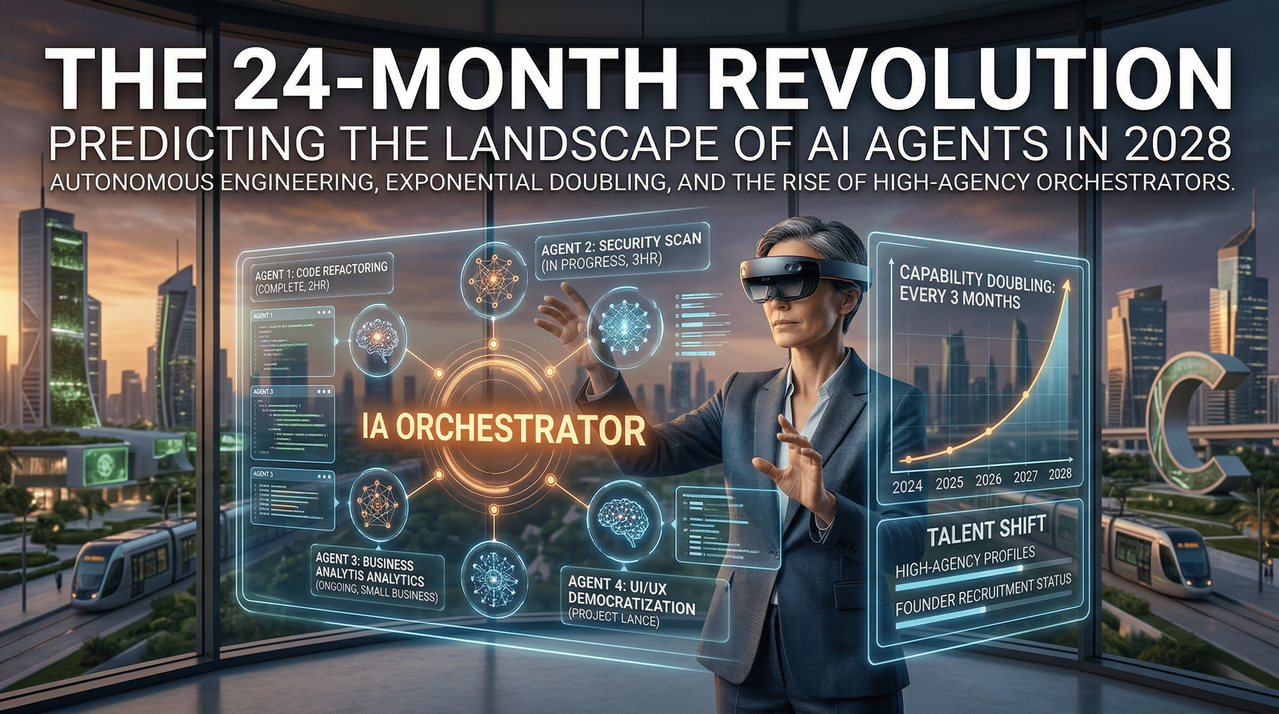
The tech industry has long been governed by Moore’s Law—a predictable, albeit blistering, pace of hardware advancement. However, as we look toward the horizon of 2028 and 2029, the leaders of the world's top AI laboratories are noticing a trend that makes Moore’s Law look sluggish. We are no longer measuring progress in years or decades, but in a relentless cycle of capability doubling that occurs every few months.
In a recent deep-dive discussion regarding the future of autonomous engineering and the evolution of AI agents like Devin, industry insiders highlighted a radical shift. The conversation moved beyond simple code completion to a future where autonomous project ownership is the standard. For developers, entrepreneurs, and governments, the message is clear: the gap between "high-agency" adopters and those waiting for the dust to settle is widening at an exponential rate.
The METR Benchmark: From Seconds to Days of Autonomy
One of the most striking metrics discussed is the METR report (formerly ARC Evals). This benchmark measures the duration of human-level work an AI model can perform autonomously before a human must intervene to correct an error or provide new direction.
The trajectory is staggering:
- 2022-2023: Models could function for roughly 10 seconds before making a critical logic error.
- 2024-2025: We have seen models (such as the discussed Opus 4.6) reach thresholds of 18 to 20 hours of human-equivalent work.
- The Projection: Capabilities are doubling four to five times per year.
If this pace holds, by 2028, we aren't just looking at an assistant that writes a function; we are looking at an agent capable of managing a three-week project—from architectural design to smoke testing—without a single human "nudge." This shift in the "form factor" of work means the human role transitions from a shepherd of code to a director of outcomes.
The Rise of the "Agent-Forward" Engineer
We are currently witnessing the birth of a new professional class: the Agent-Forward Engineer. These are developers or organizations that have already integrated agentic workflows into their core operations. The productivity gains reported are not incremental—they are transformative, ranging from 5x to 10x gains.
Large organizations and governments are beginning to realize that they cannot afford to be five times slower than their "agent-forward" competitors. This realization is triggering a massive wave of "good knowledge" acquisition. It isn't just about having the tool; it is about knowing how to architect a business process that allows an AI to run autonomously.
In the near future, the tasks we currently consider "unsolved" for AI—such as responding proactively to security vulnerabilities or executing massive legacy system upgrades—will become automated, event-driven background processes.
The Explosion of Small Businesses: AI as the Great Equalizer
One of the most profound societal predictions for 2028 is a massive renaissance in small businesses. Historically, the primary advantage of a large corporation was the "specialization of labor." A big company could afford a legal department, a financial analysis team, and a massive software engineering wing.
AI agents effectively democratize this specialization. An individual with high agency can now access:
- Legal Gut Checks: Frontier-level models providing sophisticated preliminary legal analysis.
- Financial Intelligence: Deep-dive analysis of cash flows and market trends.
- Custom Software: Building and maintaining complex digital infrastructure without a massive dev team.
By 2028, the barrier to entry for starting a sophisticated business will be lower than ever. The focus shifts from "How many people can I afford to hire?" to "How effectively can I direct my agents?" This empowerment of the individual is expected to create tens of thousands of new small business owners who operate with the efficiency of mid-sized firms.
The Talent Shift: Why the Best Companies are Hiring Founders
The recruitment landscape is undergoing an equally radical transformation. Leaders at Cognition AI have noted a peculiar trend: a significant percentage of their staff are former founders.
In an era where AI can handle the "how" of execution, the "what" and "why" become the most valuable commodities. Former founders are inherently "high-agency" individuals. They are comfortable with ambiguity, understand product trade-offs, and take initiative without waiting for a ticket in a backlog.
This shift is even being reflected in the interview process. The old guard of "Leetcoding" and hand-writing algorithms is dying. Modern, top-tier firms are now allowing—and even requiring—candidates to use as much AI as they want during the interview. The goal is no longer to see if a human can do what an AI can do. Instead, the test is: "Can you build a full product surface in three hours using every tool at your disposal?"
Companies are now evaluating:
- Product Decision-Making: Choosing the right features to build.
- Trade-off Analysis: Understanding where to cut corners and where to invest.
- Information Collection: Knowing how to prompt and guide an AI to find the right solution.
Conclusion: Preparing for the Two-Month Cycle
The most vital takeaway for 2028 is that the "world changes every two or three months." When capabilities double on such a short cycle, a "wait and see" strategy is a recipe for obsolescence.
To stay competitive, whether as a software developer in Morocco or a FinTech founder in Silicon Valley, one must adopt the agentic mindset today. The future doesn't belong to those who can code the fastest, but to those who can best orchestrate the intelligence at their fingertips. We are moving toward a world of proactive, event-driven AI, and the window to become "agent-forward" is closing fast.
The revolution is already here; it just hasn't been fully automated yet.
Comments
No comments yet. Be the first to share your thoughts!
Leave a Comment