Introduction: The Era of Simple Prompts Is Over
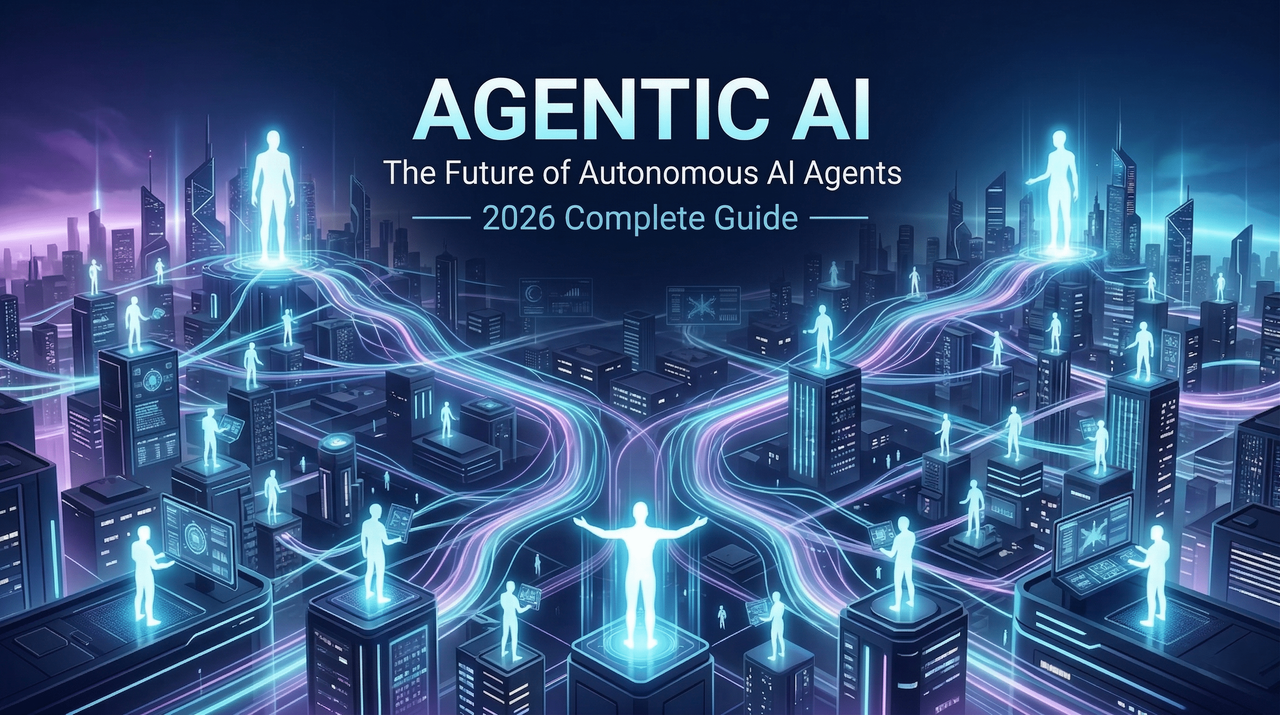
The AI landscape has undergone a seismic shift. The era of simple prompts is over — we're now witnessing the agent leap, where AI orchestrates complex, end-to-end workflows semi-autonomously. For enterprises struggling with speed-to-value, this is the defining opportunity of 2026.
We've moved past the wonder of chatbots that can summarize text and write emails. Autonomous intelligence now operates as essential technology instead of experimental technology. We are no longer just talking about chatbots that can summarize text; we are witnessing the rise of digital co-workers who can make their own decisions and create detailed plans to work across multiple platforms.
As Cisco's Kapil Bakshi noted, "the sentiment among government technology leaders has shifted from 'what is possible' to 'what can we operationalize.'" Both public and private sector leaders have observed a pivot away from chatbot capabilities and a drive towards more actionable investments in AI systems.
This article explores what agentic AI is, why 2026 is its breakout year, the market forces behind its growth, key use cases across industries, and how your organization can get started.
What Is Agentic AI?
In the two years since generative AI exploded into the mainstream, we've moved from awe at its capabilities to a more pragmatic question: What comes next? The answer is evident in the rise of agentic AI — systems that don't just respond to prompts but can reason, plan, and pursue complex, multi-step goals autonomously.
Think of the difference this way: A generative AI tool is a highly capable analyst who waits for your questions. An agentic AI system is more like an employee to whom you can delegate a project — one who will interact with other systems and return with a completed work product, or in some cases simply take the action you would otherwise have taken yourself.
Key Characteristics of Agentic AI
| Feature Traditional AI / Chatbots Agentic AI | ||
| Interaction Model | Prompt → Response | Goal → Plan → Execute → Iterate |
| Autonomy | Waits for instructions | Proactively takes action |
| Decision-Making | Recommends or summarizes | Makes decisions & executes |
| Memory | Session-based | Long-term episodic & procedural |
| Collaboration | Single model | Multi-agent orchestration |
| Scope | Single task | End-to-end workflows |
Agentic AI systems consist of coordinated agents that perceive data, reason, plan, and act with limited human intervention. They solve multi-step problems by integrating large language models with specialized modules for decision-making, workflow orchestration, memory, and planning.
Why 2026 Is the Year of Agentic AI
1. The Numbers Don't Lie
The momentum behind agentic AI is staggering:
- Industry analysts project the market will surge from $7.8 billion today to over $52 billion by 2030, while Gartner predicts that 40% of enterprise applications will embed AI agents by the end of 2026, up from less than 5% in 2025.
- In 2024, the market value of agentic AI stood at $5.1 billion. It is anticipated that this market value will surpass $47 billion, with a compound annual growth rate of over 44%, as reported by Capgemini.
- Gartner predicts that 15% of day-to-day work decisions will be made autonomously through agentic AI by 2028, up from none in 2024, while 33% of enterprise software applications will include agentic AI by the same timeframe.
- The enterprise agentic AI market has reached $7.51 billion in 2026, growing at a staggering CAGR of 27.3%.
2. From Pilots to Production
The agentic AI field is moving from experimental prototypes to production-ready autonomous systems. The data confirms this shift:
- A McKinsey survey found that 23% of companies are already scaling agentic AI systems, while another 39% are actively experimenting with them.
- According to a 2025 Gravitee survey, approximately 72% of medium-sized companies and large enterprises currently use agentic AI, and an additional 21% plan to adopt it within the next two years.
- A KPMG survey reported that 99% of organizations plan to eventually deploy agentic AI, though only 11% had reached that stage by mid-2025.
3. Technical Foundations Are Ready
Enterprise platforms now expose robust APIs. ERP, CRM, ITSM, and data platforms are increasingly interoperable. Cloud-native architectures allow real-time data exchange. This integration maturity makes it feasible for agents to operate across systems rather than within isolated tools.
The 7 Agentic AI Trends Defining 2026
Trend 1: The Rise of Multi-Agent Systems
The agentic AI field is going through its microservices revolution. Just as monolithic applications gave way to distributed service architectures, single all-purpose agents are being replaced by orchestrated teams of specialized agents.
Gartner reported a staggering 1,445% surge in multi-agent system inquiries from Q1 2024 to Q2 2025. Rather than deploying one large LLM to handle everything, leading organizations are implementing "puppeteer" orchestrators that coordinate specialist agents — a researcher agent gathers information, a coder agent implements solutions, an analyst agent validates results.
Solo agents are out. Multi-agent systems are in.
Trend 2: Governance as an Enabler, Not an Obstacle
The shift happening in 2026 is from viewing governance as compliance overhead to recognizing it as an enabler. Mature governance frameworks increase organizational confidence to deploy agents in higher-value scenarios, creating a virtuous cycle of trust and capability expansion.
Governance frameworks, auditability, explainability, and ethics will become fundamental to building enterprise trust. And trust, in turn, is the foundation for scaling AI-powered agent systems across the business.
Trend 3: Human-in-the-Loop Redefined
The narrative around human-in-the-loop (HITL) is shifting. Rather than viewing human oversight as acknowledging AI limitations, leading organizations are designing "Enterprise Agentic Automation" that combines dynamic AI execution with deterministic guardrails and human judgment at key decision points. Full automation isn't always the optimal goal.
Trend 4: From Creators to Curators
This shift necessitates a fundamental redefinition of engineering roles from creators to curators. The engineer of 2026 will spend less time writing foundational code and more time orchestrating a dynamic portfolio of AI agents, reusable components, and external services. Their value will lie in designing the overarching system architecture, defining the precise objectives and guardrails for their AI counterparts, and rigorously validating the final output.
Trend 5: Smaller, Specialized Models Power Agents
As IBM's Anthony Annunziata notes, "We're going to see smaller reasoning models that are multimodal and easier to tune for specific domains." Advances in fine-tuning and reinforcement learning mean that enterprises can adopt open-source AI. "Instead of one giant model for everything, you'll have smaller, more efficient models that are just as accurate—maybe more so—when tuned for the right use case."
Trend 6: ROI Becomes the Central Metric
AI agent ROI will be a top discussion for organizations moving forward. Those organizations that want to succeed will look for numbers and impact to prove a measurable transformation before they invest more in new tech.
A McKinsey report highlights that AI-centric organizations are achieving 20% to 40% reductions in operating costs and 12–14 point increases in EBITDA margins.
Trend 7: Operating Model Reinvention
78% of executives say they'll have to reinvent their operating models to capture agentic AI's full value. Leading organizations that are reimagining operations and managing agents as workers are finding success.
Top Agentic AI Use Cases Across Industries
In 2026, enterprises are adopting agentic AI for measurable ROI, not experimentation or pilots. Agentic AI use cases span healthcare, finance, HR, DevOps, supply chain, sales, security, and marketing. These systems reduce decision delays, operational friction, and coordination overhead at scale.
Healthcare & Life Sciences
Agentic AI autonomously analyzes patient data from clinical notes, lab reports, and medical histories, suggesting personalized treatment plans or flagging anomalies for further review. This reduces the burden on healthcare professionals and ensures that critical decisions are made swiftly and accurately.
The healthcare & life sciences segment is expected to witness the fastest growth, driven by agentic AI's capacity to cut costs and reduce staff burnout through automation. This technology streamlines administrative tasks and optimizes resource allocation. Furthermore, agentic AI accelerates drug discovery by offering quick, precise simulations.
Financial Services
Agentic AI introduces multistep workflows that continuously analyze high-velocity financial data. Use cases include adjusting credit scores, automating Know Your Customer (KYC) checks, calculating loans, and continuous monitoring of financial health indicators. These systems can fetch data beyond traditional sources, including CRM systems, payment gateways, banking data, credit bureaus, and sanction databases. Moreover, agentic AI can cross-reference entity names, addresses, and social media platforms to expose shell companies.
Retail & E-Commerce
Bain estimates that the US agentic commerce market could reach $300 to $500 billion by 2030, making up roughly 15% to 25% of overall e-commerce. Already, 30% to 45% of US consumers are using generative AI for product research and comparison.
Government & Public Sector
Today, smart technology — especially agentic AI — makes individuated services at scale increasingly achievable. Over the past decade, agencies have built digital foundations including cloud infrastructure, data exchanges, and digital identity. Layering agentic AI on top of these foundations can transform service delivery into customized platforms.
Instead of navigating multiple sites to incorporate a business, an AI agent gathers required information, auto-completes forms, and submits filings through a single interaction. Similar coordination can extend to tax filings, licensing, or benefits access.
Supply Chain & Manufacturing
At Toyota, teams are using an agentic tool to gain better visibility into the estimated time of arrival of vehicles at dealerships and will soon start using agents to resolve supply issues. The process used to involve 50 to 100 mainframe screens and significant hands-on work from supply chain team members.
Software Engineering & DevOps
We are moving beyond AI as a sophisticated coding assistant to AI as an autonomous, multi-skilled team member. Agentic AI will increasingly act as a first-pass executor across the SDLC — analyzing feasibility during planning, implementing features during build, expanding test coverage during validation, and surfacing risks during review.
Customer Service
Gartner predicts that by 2029, agentic AI will autonomously resolve 80% of common customer service issues. Agentic AI monitors delivery systems, detects delays, and initiates refunds or rebookings before customers even raise a complaint. For instance, if a courier misses a pickup window, the AI can notify the customer, offer alternatives, and trigger compensation, all autonomously. This reduces inbound ticket volume and boosts CSAT.
The Agentic AI Market: Key Statistics at a Glance
| Metric Data Point | |
| Global Market Size (2025) | $7.29 billion |
| Projected Market Size (2034) | $139.19 billion (CAGR 40.5%) |
| Enterprise Apps with AI Agents by 2026 | 40% (up from <5% in 2025) |
| Day-to-Day Decisions by AI by 2028 | 15% (up from 0% in 2024) |
| Companies Already Using Agentic AI | 72% of medium & large enterprises |
| Leaders Expecting ROI within 2 years | 92% |
| Customer Issues Resolved Autonomously by 2029 | 80% |
| US Agentic Commerce Market by 2030 | $300–$500 billion |
| Dominant Region | North America (46% share in 2024) |
| Fastest-Growing Region | Asia Pacific |
Challenges & Risks to Watch
Despite the enormous promise, agentic AI comes with significant challenges that organizations must address:
1. The "Agent Washing" Problem
Many so-called agentic initiatives are actually automation use cases in disguise. Enterprises often apply agents where simpler tools would suffice, resulting in poor ROI. This "agent washing" compounds the problem, with vendors rebranding existing automation capabilities as "agents."
2. Governance & Accountability Gaps
Enterprises struggle to establish appropriate oversight mechanisms for systems designed to operate autonomously. Traditional IT governance models don't account for AI systems that make independent decisions and take actions.
When an agentic system produces an erroneous outcome — particularly if it has taken action across multiple systems — attributing responsibility and calculating harm is considerably more complex than with traditional software failures.
3. Regulatory Complexity
AI agents that make or influence consequential decisions are drawing heightened attention from regulators. The EU AI Act imposes specific obligations around transparency, human oversight, and risk management for high-risk AI systems. Domestic attention is also growing at the state level. Organizations deploying agentic AI, particularly in regulated industries, should engage counsel early.
4. Implementation Failure Rates
Despite enthusiasm, enterprises are encountering significant obstacles translating agentic pilots into production-ready solutions. While 30% of organizations are exploring agentic options and 38% are piloting solutions, only 14% have solutions ready for deployment, and a mere 11% are actively using these systems in production. Furthermore, 42% of organizations report they are still developing their agentic strategy road map.
How to Get Started with Agentic AI: A 6-Step Framework
Step 1: Start with High-Value, Low-Complexity Use Cases
As Oracle's Patrick Puck advises, "Start with narrow, high-value use cases before attempting more sophisticated and complex workflows."
High Impact, Low Complexity quick wins deliver measurable ROI within weeks. Examples include customer support intent automation, invoice triage, or DevOps runbook execution.
Step 2: Fix Your Data Foundation
AWS describes the approach to delivering agentic AI solutions as a broader journey that must both modernize legacy infrastructure and code, as well as refine and organize data to make it actionable.
Step 3: Build Governance First
Being "AI ready" means having the right structures in place before implementing AI technology, which includes preparing infrastructure and governance.
Step 4: Adopt Multi-Agent Architecture
Design modular agent teams with clear roles: planner agents, executor agents, validator agents, and governance agents — each with defined responsibilities and interaction protocols.
Step 5: Keep Humans in the Loop (Strategically)
Implement the "delegate, review, and own" model: agents handle first-pass execution, humans review outputs for correctness and risk, and ownership of architecture and outcomes remains human.
Step 6: Measure, Iterate, Scale
The biggest ROI comes from embedding agentic AI into core workflows, not treating it as a standalone tool. Enterprises that pair agentic AI with strong governance and clear KPIs see faster, more sustainable business impact.
The Future: What's Coming After 2026?
The trajectory is clear:
- As Gartner's Anushree Verma predicts, "AI agents will evolve rapidly, progressing from task and application specific agents to agentic ecosystems." This shift will transform enterprise applications from tools supporting individual productivity into platforms enabling seamless autonomous collaboration and dynamic workflow orchestration.
- Gartner's best-case scenario projects that agentic AI could drive approximately 30% of enterprise application software revenue by 2035, surpassing $450 billion, up from 2% in 2025.
- Human work roles will experience augmentation through agentic AI technology, while complete job replacement will happen only after an extended period. The system takes charge of repetitive tasks so that professionals can dedicate their efforts to strategic work and creative projects.
Conclusion: The Window Is Open — Are You Moving Fast Enough?
In 2026, agentic automation will redraw the enterprise map. The question is no longer capability — it's control.
93% of business leaders believe those who successfully scale AI agents in the next 12 months will gain a durable competitive edge. That window is open right now.
For machine learning practitioners and technical leaders, 2026 is an inflection point where early architectural decisions will determine which organizations successfully scale agentic systems and which get stuck in perpetual pilot purgatory.
The organizations that will thrive are not the ones that understood agentic AI first — they're the ones that committed to it while everyone else was still forming a committee. The question isn't whether agentic AI belongs in your enterprise. The question is which use case you're starting with, and whether you're moving fast enough to matter.
FAQs About Agentic AI
Q: What is agentic AI in simple terms? Agentic AI describes autonomous AI systems that are capable of executing specific tasks with little to no human interaction required.
Q: How is agentic AI different from generative AI? What makes agentic AI structurally different is not better prompting, but sustained execution. Frontier models can now reason across long-running, multi-step workflows, invoking tools, interpreting results, and iterating over time.
Q: Will agentic AI replace human jobs? It will transform roles, automate repetitive tasks, and augment human capabilities, but human oversight and creativity remain essential.
Q: What industries benefit most from agentic AI? Healthcare, financial services, and retail are among the fastest adopters, with early applications in customer support, fraud detection, and supply chain optimization.
Q: How big is the agentic AI market? The global agentic AI market is projected to grow from $7.29 billion in 2025 to $139.19 billion by 2034, at a CAGR of 40.5%.

Comments
No comments yet. Be the first to share your thoughts!
Leave a Comment