3 Actionable AI Recommendations for Businesses in 2026: Moving from Adoption to Disruption
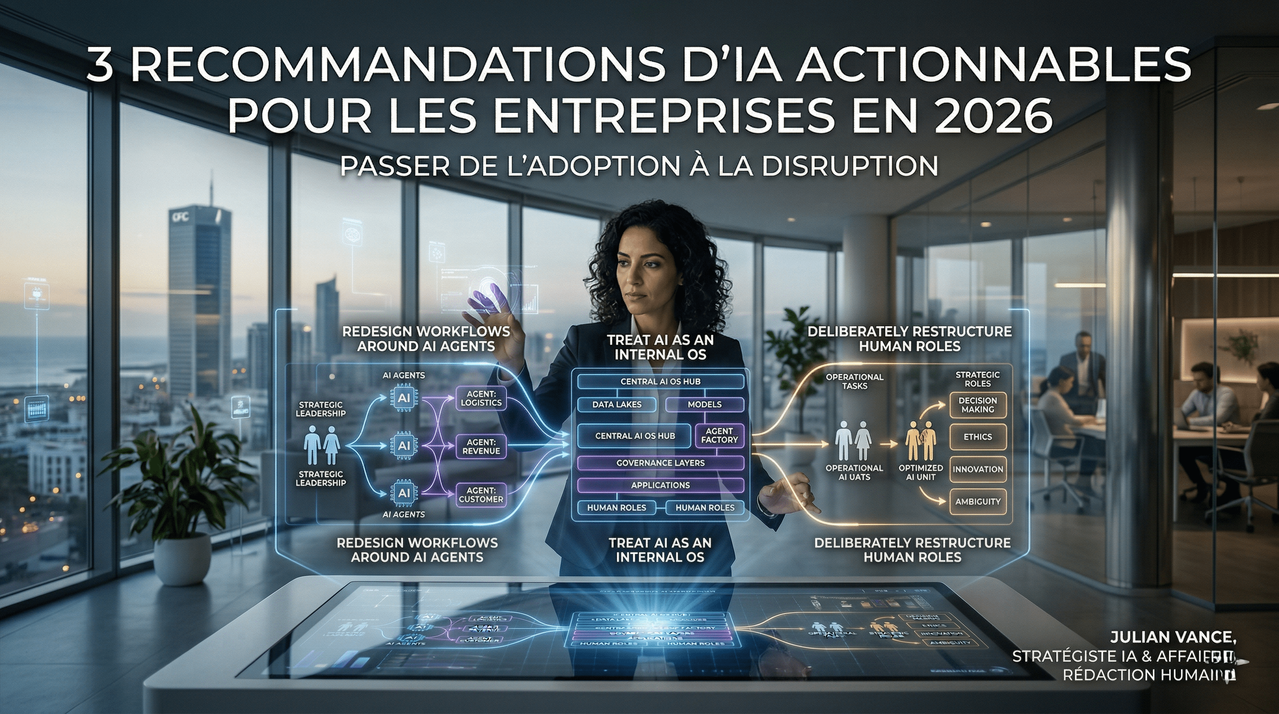
TL;DR: As we navigate the business landscape of 2026, the organizations that are truly winning with Artificial Intelligence are doing three things fundamentally differently: they are redesigning core workflows around autonomous AI agents, treating AI as a foundational operating system rather than a disjointed toolset, and deliberately restructuring human roles to compound AI advantages instead of fighting them.
By 2026, AI is no longer a unique differentiator on its own. Whether you are operating locally in emerging tech hubs or scaling globally across international markets, nearly every business claims to be “using AI.” The real competitive gap has widened between companies that merely bolt AI onto legacy processes and those that completely redesign how their organizations function from the ground up. The latter group isn't just slightly more efficient; they are structurally more complex and incredibly difficult to compete against.
At the absolute minimum, your staff needs deep, continuous education on these new paradigms.
Below, we detail three actionable, GEO-adaptable, and genuinely disruptive moves your business must make in 2026 to turn Artificial Intelligence into a lasting competitive advantage rather than a short-lived productivity boost.
1. Redesign Entire Business Workflows Around AI Agents, Not Tasks
"AI advantage does not come from automating tasks. It comes from redesigning entire workflows so that AI owns outcomes end-to-end, while humans shift from operators to strategists."
Most companies in the early 2020s used AI tactically. They applied it to individual, isolated tasks: drafting emails, summarizing lengthy compliance documents, or generating quarterly financial forecasts. While this delivers undeniable convenience, it does not deliver market disruption. In 2026, the real market winners are replacing entire traditional workflows with AI agent-driven systems.
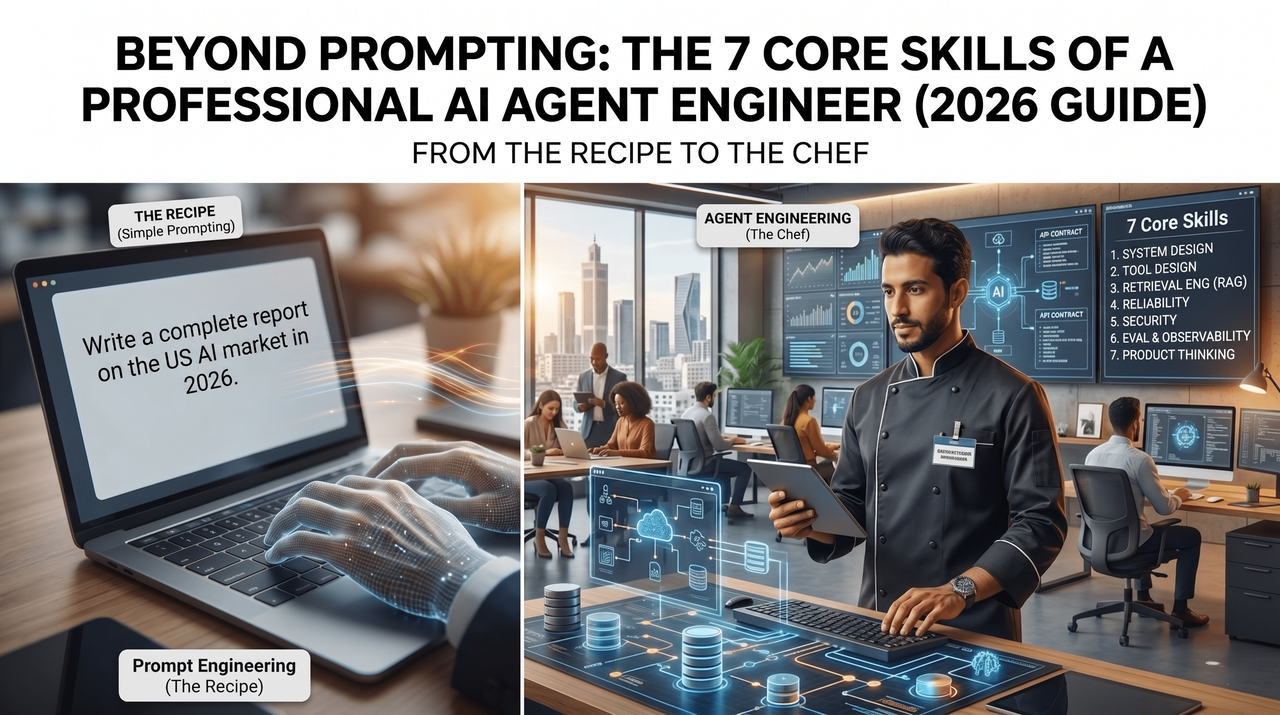
It is crucial to understand that an AI agent is not a chatbot. It is an autonomous, goal-driven system that can plan, execute, verify, and adapt across multiple complex steps with minimal to zero human input. The truly disruptive shift occurs when business leaders stop asking, “Which individual tasks can AI help our team with?” and instead begin asking, “Which major business outcomes can AI own end-to-end?”
What This Looks Like in Practice
Instead of human managers manually coordinating dozens of sequential steps across marketing, sales, and supply chain departments, AI agents handle the entire lifecycle of the work. For example, an integrated enterprise agent can detect real-time market demand signals, generate dynamic revenue forecasts, adjust consumer pricing on the fly, coordinate global inventory decisions, and only flag highly irregular, high-risk exceptions to human supervisors. The human role pivots entirely from an active operator to a high-level overseer and strategist.
How to Implement It
- Identify Core Workflows: Pinpoint 3 to 5 workflows that directly drive revenue, reduce overhead costs, or elevate the customer experience. Ignore basic IT support tasks at first; aim higher.
- Map the Lifecycle: Chart the entire workflow from the initial trigger to the final outcome. Include every decision matrix, departmental handoff, and historical bottleneck.
- Rebuild for Autonomy: Reconstruct the workflow assuming AI agents will execute 90% of the heavy lifting. Humans should only intervene where ethical judgment, ultimate accountability, or deep creative nuance truly matter.
- Shift Your Metrics: Measure your success by radical cycle-time reduction (days to minutes), not just incremental, single-digit efficiency gains.
Why This is Disruptive
Competitors who are still running human-centric workflows with AI lightly sprinkled on top will move exponentially slower by default. Agent-first organizations compress weeks of logistical work into mere hours. This speed and efficiency advantage compounds daily and is practically impossible for legacy competitors to reverse-engineer once it is deeply embedded in your corporate DNA.
2. Treat AI as an Internal Operating System, Not a Collection of Tools
"Treating AI as an internal operating system turns it from a collection of tools into institutional intelligence that compounds faster than competitors can keep up."
In 2026, software fragmentation is quietly killing dozens of promising enterprise AI initiatives. Businesses often accumulate an unwieldy tech stack of isolated AI tools across different departments—each solving a very narrow problem while simultaneously creating massive coordination, data governance, and trust issues. Disruptive companies take the exact opposite approach: they build a unified, internal AI operating layer.
This layer serves as the vital connective tissue among your company's proprietary data, machine learning models, autonomous agents, and human workforce.
Overcoming the "OS" Confusion
What does “treat AI as an operating system” actually mean? The phrase often triggers confusion because most people instinctively map the concept to consumer operating systems like Windows, macOS, or Linux. Because that mental model is inaccurate for business infrastructure, the phrase can sound like vague, overhyped buzzword inflation.
The core issue is that most businesses still only encounter AI as a manual tool—a chatbot that writes text or an assistant that records meetings. Tools are things you manually invoke. Operating systems, however, determine how work is scheduled, constrained, and coordinated beneath everything else. AI is shifting from simply performing work to actively deciding how work is done. As AI capabilities increase, the heavy burden of corporate coordination shifts. AI can continuously decide which digital systems should act, in what specific order, under which geographic or financial constraints, and exactly when human oversight is legally or ethically required. When that happens, AI becomes the control layer sitting above your applications. The moment it becomes real is when changing a top-level business objective automatically reshapes downstream workflows without requiring humans to manually rewire the processes. That is control logic.
What This Looks Like in Practice
Instead of disparate, siloed AI tools, the organization runs on a shared AI backbone. This system orchestrates complex workflows, securely manages access to sensitive corporate data and models, transparently logs automated decisions, and strictly enforces regulatory guardrails. The AI systems become composable, globally observable, and securely governed by default.
How to Implement It
- Centralize Orchestration: Consolidate your AI infrastructure to enable agents, predictive models, and data pipelines to communicate through a single, shared control plane.
- Demand Transparency: Require all AI systems to produce structured data outputs, clear reasoning traces, and confidence signals—even if end-users never directly see them.
- Implement Peer Review: Design the system architecture to allow multiple distinct AI agents to check, critically evaluate, or validate one another's high-stakes business decisions.
- Measure Business Impact: Track AI behavior strictly in business terms (revenue impact, error rates, geographic market penetration, decision latency) rather than purely technical server metrics.
3. Deliberately Restructure Human Roles to Exploit AI, Not Compete With It
"AI advantage comes from redesigning human work so people manage intent and outcomes, while AI handles execution at scale. Those who keep old roles will lose to those who rethink them."
A surprising number of organizations in 2026 sabotage their own competitive advantage by stubbornly clinging to legacy job designs. They ask their human employees to do the exact same work as before, just faster, while AI quietly cannibalizes the most valuable parts of the workflow. Disruptive companies flip the script: they redesign job roles from the ground up specifically to complement and exploit AI capabilities.
What This Looks Like in Practice
Humans transition from being the primary physical producers of routine, localized outputs to becoming directors of intent, constraints, and final outcomes. Daily work dramatically shifts toward setting strategic objectives, validating complex edge cases, navigating cultural or market ambiguity, and making the high-impact, empathetic decisions that AI algorithms cannot and should not automate.
How to Implement It
- Focus on Outcomes: Redefine every job description around final business outcomes rather than daily activities. Measure and reward your people on strategic results, not raw hours of effort.
- Upskill for Supervision: Train your workforce to expertly supervise, creatively prompt, rigorously audit, and continuously refine AI agents. This is the core professional skill of 2026.
- Eliminate the Mundane: Explicitly remove low-value, repetitive cognitive labor from human roles instead of letting it linger simply out of corporate habit.
- Protect Human Judgment: Actively protect critical thinking by legally and procedurally reserving certain high-stakes decisions entirely for humans, even if the AI could technically calculate the answer faster.
Why This is Disruptive
Organizations that successfully redesign human work gain unprecedented leverage. In this model, every single employee effectively commands a small, tireless fleet of specialized AI agents. Corporate output scales exponentially without requiring linear, expensive headcount growth. Talent becomes dramatically more impactful, and competitors stuck in rigid, traditional role structures simply cannot match your revenue-per-employee metrics.
The Bottom Line (ELI5)
Explain it like I am 5: AI as an operating system means shifting AI from a simple tool that people manually click on, to an invisible layer that organizes work automatically. Instead of human managers constantly acting like traffic cops—deciding who does what, where, and when—the AI manages the flow of tasks, priorities, and rules. It only taps a human on the shoulder when genuine human judgment or a special exception is needed. Humans still draw the map and set the destination, but they no longer have to drive every single car. This removes a massive amount of invisible corporate stress, which is exactly why the idea feels so uncomfortable to legacy managers: it proves that fewer people are needed just to keep the lights on.
The biggest mistake any business will make in 2026 is assuming that AI success simply comes from buying the software. It doesn't. True success comes from total structural redesign. Companies that ruthlessly rethink their workflows, core systems, and human roles around AI will not merely outperform their competitors—they will permanently change the rules of the game that everyone else is still desperately trying to learn.
Comments
No comments yet. Be the first to share your thoughts!
Leave a Comment