
The Ultimate AI Engineering Hub Breakdown: 10 Agentic Open-Source Projects You Must Fork Today
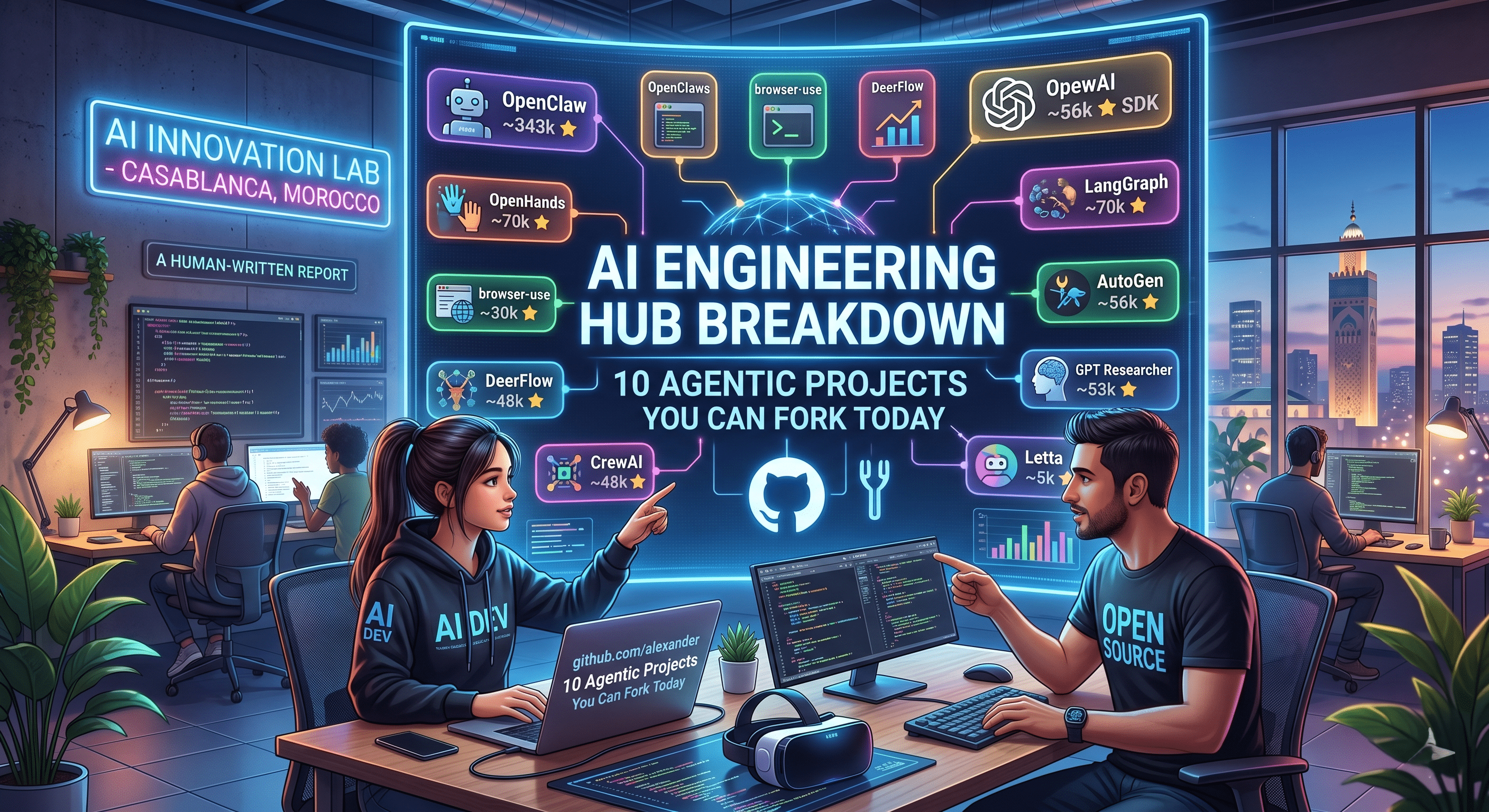
Executive Summary: The transition from simple conversational Large Language Models (LLMs) to autonomous, action-oriented AI agents is the defining technological shift of our time. For developers, data scientists, and tech entrepreneurs worldwide—from Silicon Valley to emerging tech hubs globally—reading whitepapers is no longer enough. To master agentic AI, you need to get your hands dirty. This comprehensive report breaks down the top 10 open-source agentic projects available today.
The Shift to Agentic Engineering
If you want to learn agent engineering by doing instead of just reading theoretical research, the most effective method remains unchanged: fork real repositories, run them locally, and modify them for your specific enterprise or personal use cases. This is where the real learning happens. We are moving past the era of standard prompt engineering and entering the era of "Agentic Workflows."
Modern AI agents do not just generate text; they plan, reason, browse the web, write code, and execute multi-step workflows over extended periods. To help you navigate this rapidly expanding ecosystem, I have hand-picked the 10 best open-source repositories. These projects are both highly useful and widely recognized by the global developer community. By studying these codebases, you will understand exactly how production-grade agent applications are being architected today. Let’s dive into the breakdown.
1. OpenClaw: The Future of Personal AI
GitHub Stars: ~343k ⭐ | Best For: Consumer-facing AI, multi-channel assistants
OpenClaw is the definitive starting point if you want to understand what the next wave of localized, personal AI assistants will look like. Unlike cloud-locked commercial models, OpenClaw is designed as a personal assistant that runs directly on your own devices, prioritizing data privacy and user control.
What makes OpenClaw truly exceptional is its native integration with the communication tools people already use daily across the globe: WhatsApp, Telegram, Slack, Discord, Signal, and iMessage. It transcends the basic chat-interface demo. With robust multi-channel support, advanced voice interaction features, and a highly extensible ecosystem for adding custom skills, it feels like a fully realized product. If you want a repository that mimics a production-ready personal agent system, OpenClaw is unparalleled.
2. OpenHands: Autonomous AI-Driven Development
GitHub Stars: ~70k ⭐ | Best For: Software engineers, DevSecOps, automated coding
OpenHands is an essential repository to fork if your primary interest lies in coding agents and automated software engineering. Positioned as an open-source alternative to proprietary coding agents, it is built entirely around AI-driven development.
The project has cultivated a massive surrounding ecosystem, featuring comprehensive cloud deployment options, thorough documentation, a powerful CLI, a dedicated SDK, benchmarking tools, and continuous integration pipelines. This matters because you are not just looking at a clever script; you are studying a complete enterprise architecture. You can dissect the core agent logic, evaluate the user interface, and observe how the maintainers approach rigorous AI evaluation. For customizing your own autonomous developer, this is the most practical starting point.
3. Browser-Use: Bridging Agents and the Web
GitHub Stars: ~85k ⭐ | Best For: Web scraping, automated testing, RPA
Browser-use tackles one of the most persistent challenges in AI: interacting with dynamic web interfaces. The core concept is elegantly simple: it makes standard websites infinitely easier for AI agents to navigate and manipulate, drastically reducing the friction of browser-based tasks.
Since a vast majority of real-world agentic work ends up in the browser—data entry, form filling, competitive research, UI navigation, and repetitive online workflows—this repository is incredibly valuable. It comes packed with supporting repositories and practical examples, allowing developers to transition quickly from theoretical curiosity to deploying agents in automated web environments.
4. DeerFlow: Mastering Long-Horizon Tasks
GitHub Stars: ~55k ⭐ | Best For: Complex research, long-running background tasks
DeerFlow represents the cutting edge of long-horizon agent systems. Most basic agents fail when tasked with multi-day or highly complex, multi-step instructions. DeerFlow solves this by acting as an open-source "super-agent" harness.
It intelligently brings together specialized sub-agents, robust memory systems, secure code execution sandboxes, and dynamically loaded tools to research, code, and create over extended periods. It moves far beyond simple API tool-wrapping. DeerFlow actively manages the complex infrastructure required to maintain agent focus and contextual awareness over time. If your goal is to build resilient systems that handle massive tasks, DeerFlow is a must-fork.
5. CrewAI: Accessible Multi-Agent Orchestration
GitHub Stars: ~48k ⭐ | Best For: Python developers, multi-agent collaboration
CrewAI remains one of the most intuitive and accessible repositories for multi-agent orchestration. Built as a fast, flexible framework for multi-agent automation, it operates independently, avoiding the heavy abstractions sometimes found in older frameworks.
The mental model of CrewAI is brilliantly simple: you create "agents," assign them "tasks," and group them into a "crew" that works together to achieve a goal. The setup is highly approachable, and the documentation is exceptionally friendly for beginners while maintaining production-level utility. If you want a Python-first framework that you can immediately transform into a functional, multi-agent business process, CrewAI deserves a permanent spot in your toolkit.
6. LangGraph: Stateful Agent Engineering
GitHub Stars: ~28k ⭐ | Best For: Production-grade systems, complex control flows
LangGraph is the repository to study when you are ready to transition from flashy demos to rigorous software engineering. Developed by the team behind LangChain, it is categorized as a low-level orchestration framework specifically designed for long-running, stateful, and highly controllable agents.
LangGraph forces you to think like an architect—in terms of graphs, state machines, explicit control flows, and system resilience. It is indispensable if you want to graduate from basic "prompt-plus-tool" loops and understand how serious, enterprise-ready agent runtimes are constructed. While the learning curve is steeper than CrewAI, the architectural lessons it teaches are invaluable for building reliable AI software.
7. OpenAI Agents SDK: The Lightweight Powerhouse
GitHub Stars: ~20k ⭐ | Best For: Clean architectures, direct OpenAI integration
The OpenAI Agents SDK (often associated with their "Swarm" conceptual framework) is the premier option for developers seeking a lightweight, modern, and highly efficient workflow. It is engineered as a compact framework for multi-agent orchestration, heavily prioritized for production readiness.
By keeping the core building blocks minimal, it provides developers with direct, unabstracted control over tools, agent handoffs, session management, tracing, and real-time interaction patterns. You don't have to wade through layers of convoluted framework logic to see how the system operates. For engineers who favor simple API surfaces and maintainable codebases, this is a top-tier exploration target.
8. AutoGen: Microsoft's Enterprise Framework
GitHub Stars: ~56k ⭐ | Best For: Distributed systems, enterprise workflows, complex simulations
Developed by Microsoft, AutoGen remains one of the most consequential and heavily cited repositories in the multi-agent space. Positioned as a comprehensive programming framework for agentic AI, its documentation delves deep into serious enterprise applications: automated business workflows, academic research collaboration, and distributed multi-agent systems.
AutoGen belongs on this list because the sheer volume of knowledge embedded in its codebase is staggering. The dynamic conversation patterns between agents, the error-correction loops, and the overall framework design are masterclasses in AI orchestration. It is a foundational project that has influenced almost every other tool in this category.
9. GPT Researcher: Autonomous Deep Research
GitHub Stars: ~26k ⭐ | Best For: Academic research, financial analysis, automated reporting
If you prefer to study a highly specialized agent rather than a generalized framework, GPT Researcher is the perfect candidate. It is a fully autonomous agent engineered specifically for deep, comprehensive research, utilizing any major LLM provider.
The codebase elegantly demonstrates how to handle multi-agent research aggregation and dynamic report generation. It provides a crystal-clear, start-to-finish workflow: task planning, web browsing, source aggregation, critical synthesis, and final reporting. For developers looking for concrete, highly practical implementation patterns over abstract orchestration theories, GPT Researcher is incredibly forkable and instantly valuable.
10. Letta: Memory as the Core Architecture
GitHub Stars: ~22k ⭐ | Best For: Persistent AI companions, long-term state management
Letta (evolving from the original MemGPT concepts) stands out by fundamentally shifting the architectural focus: it places long-term memory and state management at the very center of agent design.
The repository functions as a platform for building stateful agents equipped with advanced, tiered memory systems (combining core memory and archival memory) that allow the AI to learn, adapt, and improve over time. While many frameworks focus purely on task orchestration, Letta addresses the critical missing piece of the puzzle: persistence. If you are building customer service agents, personal companions, or any system that cannot afford to start with a blank slate every single session, Letta is the repository you need to explore.
Final Thoughts for AI Builders
The transition into agentic engineering requires more than theoretical knowledge; it requires active participation in the open-source ecosystem. Whether you are building localized consumer apps optimized for global geo-distribution, or massive enterprise automation tools, the code you need to learn from is already publicly available.
My advice? Pick one repository from this list that aligns with your current business or personal goals. Clone it, run the installation scripts, break the code, and piece it back together. The future of software is agentic, and the best way to predict that future is to build it yourself.


Comments
No comments yet. Be the first to share your thoughts!
Leave a Comment