

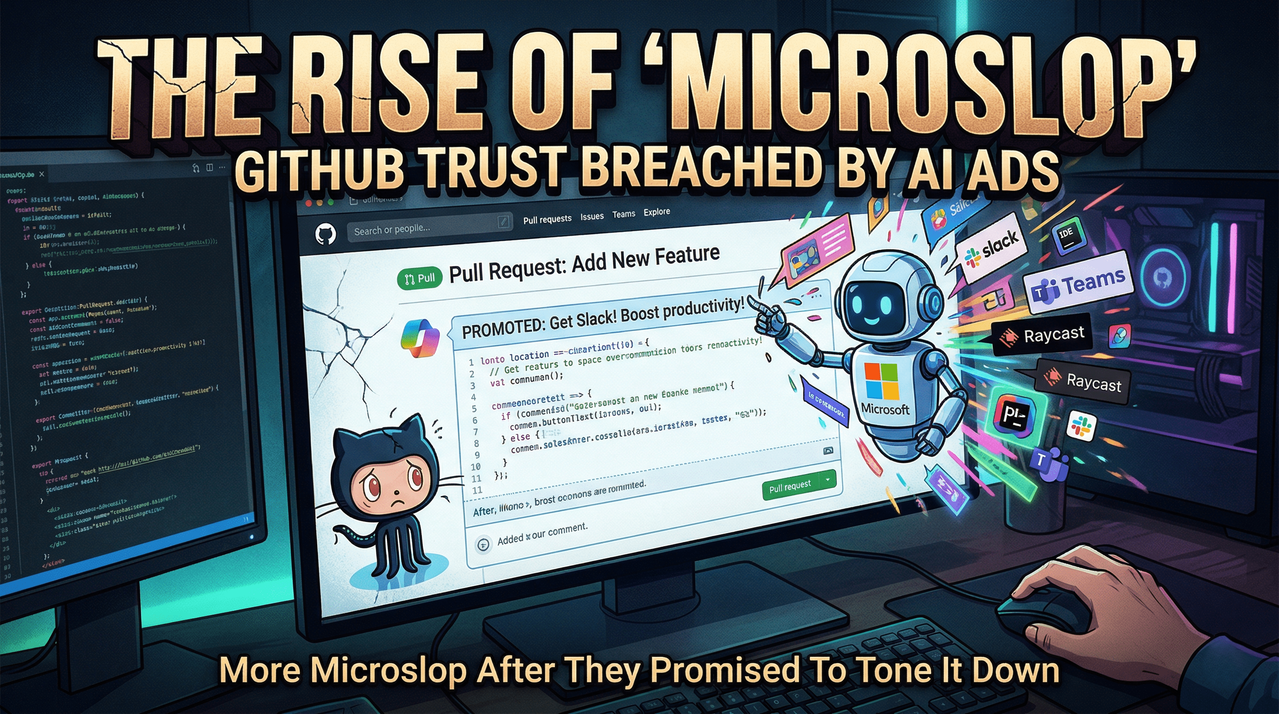
The Return of "Microslop": Why Microsoft’s GitHub Ad Injection Is a Massive Breach of Trust
When Microsoft acquired GitHub back in 2018, the developer community held its collective breath. The tech giant, long haunted by its "Embrace, Extend, and Extinguish" reputation, promised to be a neutral steward of the world’s most important code repository. For a few years, they seemingly kept that promise. However, recent events involving GitHub Copilot have reignited old fears, proving that the corporate urge to monetize every pixel is alive and well in Redmond.
The Incident: Ads in Your Documentation
The controversy erupted when developers began noticing something strange in their pull request (PR) descriptions. Without warning, consent, or even a toggle in the settings, Microsoft began injecting advertisements into the text fields of PRs. These weren't just subtle links; they were mentions of third-party tools and services like Raycast, Slack, Teams, and various IDEs.
For the uninitiated, a Pull Request is the holy grail of collaborative coding. It is a formal record of why a change was made, what it does, and how it was tested. It is documentation that lives as long as the project does. To have a third-party AI—or worse, a marketing department—silently append promotional material to a developer's professional work is not just a nuisance; it is a violation of the integrity of the development process.
The "Microslop" Phenomenon
The term "Microslop" has started circulating again in developer forums, and for good reason. It refers to the gradual degradation of a product's quality through the forced integration of unnecessary AI features, telemetry, and advertisements.
Microsoft had previously signaled that they heard the community’s complaints about "AI fatigue." They promised to tone down the aggressive "Copilot-in-everything" strategy. Yet, this incident puts the lie to those claims. By sneaking ads into PRs, Microsoft demonstrated a fundamental misunderstanding of their primary audience. Developers don't view GitHub as a social media feed to be monetized; they view it as a precision tool.
Why the Backlash Was So Intense
It wasn't just about the ads themselves. The outrage stems from a much deeper concern regarding data sovereignty and trust. ### 1. The Modification of User Content If Microsoft feels entitled to modify the description of a PR without the author's knowledge, where does that authority end? This is the "slippery slope" that has many engineers looking toward GitLab or self-hosted Bitbucket instances. If they can add a line about Slack to your description, what’s stopping them from "optimizing" your code with a snippet that happens to favor a Microsoft-owned library?
2. The Silent Nature of the Change
There was no notification. No "Opt-in" checkmark. No "Copilot would like to suggest a tool" popup. The text was simply there. In the world of version control, "unauthorized changes" are the stuff of nightmares. This move bypassed the most basic rule of the developer-platform relationship: Do not touch the user's data.
3. Stealing the Spotlight
Pull requests are often used as part of a developer's portfolio or a company's internal audit trail. Having corporate "slop" injected into a professional contribution makes the developer look like they are shilling for products they might not even use. It undermines the professional image of the contributor.
The Corporate "Reflection" and Reversal
Following a massive wave of backlash on X (formerly Twitter), Reddit, and GitHub's own feedback forums, Microsoft quickly reversed course. Thomas Dohmke and other leadership figures had to step in to do damage control.
Thomas Rogers, a key figure in the project, eventually stated that "on reflection," allowing Copilot to make changes to human-written PRs without knowledge was the "wrong judgment call." While the reversal is welcome, it feels reactive rather than principled. The fact that this feature passed through planning, development, testing, and deployment without anyone at Microsoft saying, "Wait, won't developers hate this?" is a massive red flag regarding the current culture at the company.
The Broader Implications for AI Ethics
This incident serves as a case study for the current state of Generative AI in the workplace. Companies are so desperate to find ROI for their massive AI investments that they are willing to sacrifice user trust.
We are seeing a trend where AI is no longer a "copilot" (helping the user) but an "agent" (acting on behalf of the corporation). When an AI starts modifying your workspace to serve the company's bottom line rather than your productivity, it is no longer a tool; it is an intruder.
SEO Analysis: What This Means for the Future of GitHub
For those tracking the tech industry, keywords like GitHub Copilot alternatives, AI developer ethics, and Microsoft privacy concerns are trending.
If Microsoft wants to maintain its dominance in the DevOps space, it must realize that developers are not "users" in the same way that Windows or Xbox users are. Developers are creators who require absolute control over their environment. Every time "Microslop" creeps into the IDE or the repository, the value of the platform diminishes.
Conclusion: A Warning to the Industry
The "More Microslop" saga is a reminder that even the most powerful tools can be ruined by poor governance. Microsoft has a long road ahead to rebuild the trust they burned for the sake of a few ad impressions.
As developers, we must remain vigilant. The tools we use to build the future should not be used to manipulate our work behind our backs. If the "Copilot" can’t stay in its seat and keep its hands off the controls, it might be time to find a new navigator.




Comments
No comments yet. Be the first to share your thoughts!
Leave a Comment