

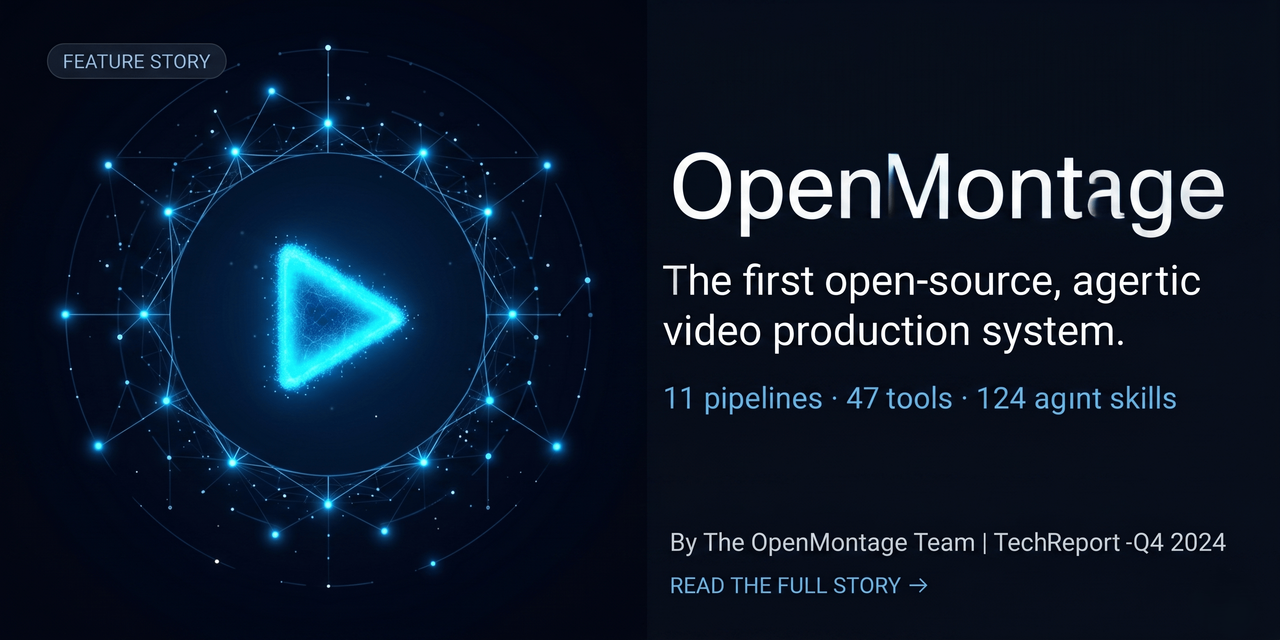
OpenMontage: The Open-Source AI Agent Video Production System
Introduction: The Rise of Agentic Video Production
The content creation industry has witnessed remarkable advances in individual AI capabilities over the past several years. Text generation, image synthesis, video generation, and voice cloning have each matured into powerful standalone tools. However, the challenge has always been integration. How do you combine these disparate capabilities into a coherent production workflow without spending hours on manual coordination?
OpenMontage answers this question with an elegant solution. Rather than building yet another monolithic video editing application, the developers created a coordination layer that transforms existing AI coding assistants into video production directors. Whether you prefer Claude Code, Cursor, GitHub Copilot, or Windsurf, your chosen assistant becomes the orchestrator of an entire production pipeline.
The system comprises 11 distinct production pipelines and integrates 49 specialized tools, creating what is arguably the most comprehensive open-source video production framework available today. The proof of concept speaks for itself: a complete product announcement video produced for a total cost of sixty-nine cents.
Technical Architecture and Capabilities
Research-First Methodology
What distinguishes OpenMontage from simpler automation tools is its commitment to research-driven content creation. Before the system writes a single word of script, it conducts between fifteen and twenty-five searches across multiple platforms. These searches span YouTube for existing content analysis, Reddit for community sentiment and trending topics, and various news websites for current information and context.
This research-first approach ensures that generated content is not merely coherent but also relevant, timely, and informed by real-world data. The agent synthesizes findings from these searches to construct narratives that resonate with target audiences and reflect current market conditions.
Video Generation Provider Ecosystem
OpenMontage supports an impressive array of twelve video generation providers, offering flexibility for different use cases and budget constraints. Cloud-based options include industry leaders such as Kling, Runway Gen-4, Google Veo 3, and MiniMax. For users preferring local processing or seeking to minimize API costs, the system integrates with GPU-based solutions including WAN 2.1, Hunyuan, and CogVideo.
This multi-provider architecture allows users to select the optimal tool for each specific shot or sequence. A talking head segment might utilize one provider known for realistic human rendering, while an abstract product visualization might leverage another service with superior motion graphics capabilities.
Image Generation Capabilities
The platform integrates eight image generation providers to support diverse visual requirements. Cloud services include Flux, Google Imagen 4, and DALL-E 3, each offering distinct aesthetic qualities and technical strengths. For offline operation or cost-sensitive projects, locally-run Stable Diffusion provides a capable alternative without per-image API charges.
Voice and Audio Production
Audio production receives equally comprehensive treatment through four text-to-speech providers. ElevenLabs delivers premium voice cloning and emotional range for professional narration. Google contributes access to over seven hundred distinct voices across multiple languages and accents. OpenAI provides its increasingly capable TTS offerings. For completely offline and cost-free operation, Piper enables local voice synthesis without internet connectivity or API expenses.
Subtitle Generation and Integration
OpenMontage incorporates WhisperX for word-level transcription, automatically generating and burning subtitles into final renders. This feature proves particularly valuable for social media content, where the majority of viewers watch videos without sound. Word-level timing ensures that subtitle animations remain synchronized with speech patterns, creating a polished viewing experience.
Motion Graphics and Animation
The system leverages Remotion for React-based motion graphics composition. This integration enables spring physics animations, smooth transitions, and TikTok-style visual explanations that have become standard expectations for contemporary video content. Developers familiar with React can extend and customize animation templates, while non-technical users benefit from pre-built motion graphics libraries.
Budget Management and Cost Control
Perhaps the most innovative aspect of OpenMontage is its sophisticated budget management system. Before executing any production step, the agent estimates associated costs and presents them for review. Any individual action exceeding fifty cents requires explicit user approval, preventing runaway expenses during experimentation.
The system enforces a hard maximum budget of ten dollars per project, ensuring that even failed experiments or iterative refinement cycles remain financially manageable. This approach democratizes professional video production, making it accessible to independent creators, small businesses, and organizations with limited marketing budgets.
Case Study: Product Announcement Production
The flagship demonstration of OpenMontage capabilities involved producing a complete product announcement video. The final output included four AI-generated images showcasing the product, professional text-to-speech narration, royalty-free background music, word-level subtitle integration, and Remotion-powered data visualizations presenting product specifications and benefits.
Total production cost: sixty-nine cents.
This figure includes all API calls for research, image generation, voice synthesis, and video rendering. The resulting video met quality standards suitable for social media distribution, email marketing campaigns, and website embedding.
Implications for Content Creation Industry
The emergence of systems like OpenMontage signals a fundamental shift in video production economics. Traditional production workflows requiring multiple specialized professionals can now be compressed into agent-orchestrated pipelines operating at marginal costs.
This transformation does not eliminate the need for human creativity and strategic direction. Rather, it amplifies human capabilities by handling technical execution while creators focus on conceptualization, brand alignment, and audience strategy. The most effective implementations will likely combine AI efficiency with human oversight and creative judgment.
For marketing departments and content agencies, OpenMontage represents an opportunity to dramatically increase output volume without proportional budget increases. For independent creators and small businesses, it removes financial barriers that previously made professional video content inaccessible.
Conclusion and Future Outlook
OpenMontage demonstrates that the future of video production lies not in any single AI capability but in intelligent orchestration of multiple specialized tools. By transforming familiar coding assistants into production directors, the system leverages existing workflows while dramatically expanding their scope.
As individual AI capabilities continue advancing, orchestration frameworks like OpenMontage will become increasingly powerful. The sixty-nine cent product announcement of today may evolve into full documentary production or episodic content creation tomorrow.
For organizations and creators evaluating AI video production tools, OpenMontage merits serious consideration. Its open-source nature ensures transparency, customizability, and freedom from vendor lock-in. Its multi-provider architecture provides resilience and optimization flexibility. And its budget management features make experimentation financially safe.
The video production revolution is not approaching. It has arrived.


Comments
No comments yet. Be the first to share your thoughts!
Leave a Comment