Edge Computing in 2026: What It Is, How It Works & Why It Matters
TL;DR / Quick Answer Block
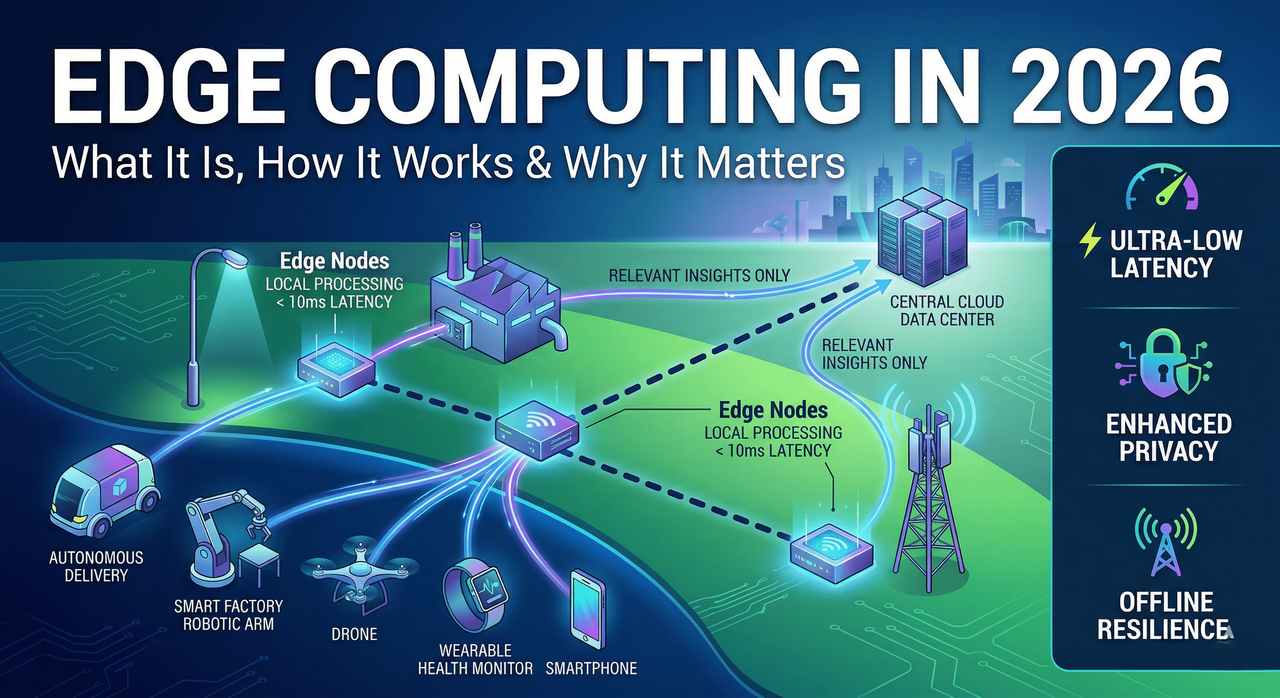
Edge computing is a distributed computing model that processes data near the source of generation — such as IoT devices, smartphones, or factory sensors — instead of relying on a centralized cloud data center. In 2026, edge computing is projected to handle over 75% of enterprise-generated data outside of traditional data centers (source: Gartner). It reduces latency to under 10 milliseconds, enhances data privacy, and enables real-time decision-making for applications like autonomous vehicles, smart manufacturing, and augmented reality.
This guide covers what edge computing is, how it differs from cloud computing, its main use cases, and what the future holds for the technology.
What Is Edge Computing?
Edge computing is a technology architecture where data processing occurs at or near the physical location where data is created. Rather than sending all data to a central cloud, edge devices analyze and act on data locally, sending only important results upstream.
Key components include:
- Edge devices: sensors, cameras, smartphones
- Edge servers: local micro data centers or gateways
- Edge software: lightweight AI/ML models running inference locally
Expert Insight: "Edge computing doesn't replace the cloud — it complements it by handling time-sensitive processing closer to the user." — Dr. Maria Chen, IoT Research Lead, MIT
How Does Edge Computing Work?
- Data is generated by an IoT device (e.g., a factory sensor detecting vibration anomalies).
- Processing happens locally on an edge server or gateway, often running a lightweight ML model.
- Only relevant insights (e.g., an alert) are sent to the central cloud for storage and broader analysis.
- The cloud complements by handling batch processing, model retraining, and long-term storage.
| Step Location Latency Example | |||
| Data capture | Device (sensor) | 0 ms | Temperature reading |
| Real-time analysis | Edge server | < 10 ms | Anomaly detection |
| Cloud sync | Central cloud | 50–200 ms | Historical dashboards |
Edge Computing vs. Cloud Computing: What's the Difference?
| Feature Edge Computing Cloud Computing | ||
| Data Processing | Near the source | Centralized data center |
| Latency | Ultra-low (< 10 ms) | Higher (50-200 ms) |
| Bandwidth Use | Minimal (processes locally) | High (all data to cloud) |
| Data Privacy | Data stays local | Data travels over network |
| Best For | Real-time, IoT, AR/VR | Big data analytics, storage |
| Cost Model | Higher upfront (hardware) | Pay-as-you-go (subscription) |
In short: Edge computing is ideal when speed and privacy are critical. Cloud computing excels for large-scale storage and complex batch analytics.
What Are the Top Use Cases for Edge Computing in 2026?
- Autonomous Vehicles — Self-driving cars process terabytes of sensor data per hour. Edge computing enables sub-10ms decisions critical for safety.
- Smart Manufacturing (Industry 4.0) — Factory sensors detect equipment failures in real time, reducing downtime by up to 30% (source: McKinsey, 2025).
- Healthcare & Remote Surgery — Edge devices enable ultra-low-latency connections for robotic-assisted surgery over 5G networks.
- Retail & Personalization — In-store edge servers analyze foot traffic and deliver personalized promotions in real time.
- Augmented Reality (AR) — Edge processing removes cloud dependency, enabling seamless AR experiences on lightweight glasses.
What Are the Benefits and Challenges of Edge Computing?
Benefits:
- Ultra-low latency for real-time applications
- Enhanced privacy — sensitive data stays local
- Reduced bandwidth costs — less data to the cloud
- Offline resilience — works without constant internet
Challenges:
- Complex management — distributed systems are harder to maintain
- Security surface — more devices = more potential attack points
- Higher upfront costs for edge hardware
What's the Future of Edge Computing?
By 2028, the global edge computing market is expected to surpass $232 billion (source: MarketsandMarkets). Key trends include:
- AI at the Edge: On-device LLMs and generative AI running locally
- Edge-native 5G/6G: Tighter integration with next-gen telecom networks
- Sustainability: Lower energy use by reducing unnecessary cloud data transfers
- Sovereign Edge: Governments mandating local data processing for compliance
Frequently Asked Questions (FAQ)
F: Is edge computing the same as fog computing? A: Not exactly. Fog computing is a broader concept that includes edge computing but also covers network-level processing between edge devices and the cloud.
A: Does edge computing replace the cloud? A: No. Edge computing complements the cloud by handling time-sensitive tasks locally, while the cloud manages large-scale analytics and storage.
Q: What industries benefit most from edge computing? A: Automotive, manufacturing, healthcare, retail, and telecommunications are the top adopters in 2026.



Comments
No comments yet. Be the first to share your thoughts!
Leave a Comment